
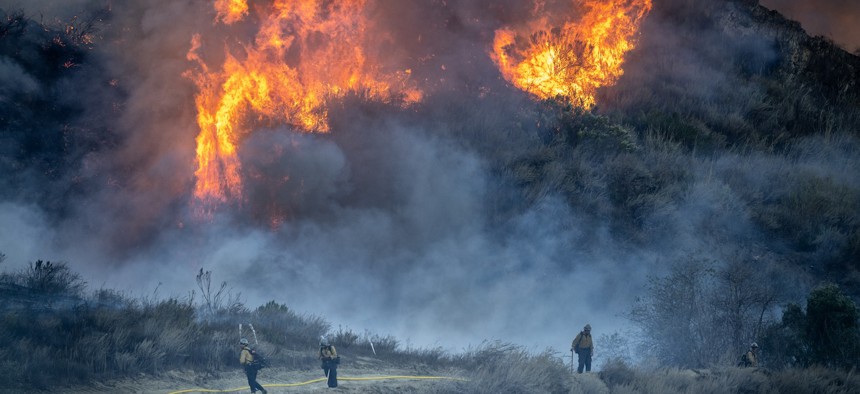
Together the Agriculture and Interior departments employ most federal wildland firefighters. Hans Gutknecht/MediaNews Group/Los Angeles Daily News via Getty Images





OPM proposes hazard pay for more federal firefighting activities
Under recently unveiled regulations, federal wildland firefighters would be eligible for a 25% increase in pay when they work on prescribed burns, a proactive tool to mitigate the risk of wildfires.

The Office of Personnel Management proposed new regulations last week that would increase the pay that federal wildland firefighters receive when they work on prescribed burns.
The federal government for years has struggled to attract and retain employees to fight wildfires. Prior to the Biden administration, many made less than $15 per hour, well below similar jobs working for state and local governments.
That changed, thanks to a provision of the 2021 bipartisan infrastructure law, which allocated money to boost firefighter salaries by $20,000 per year or 50% of their base pay, whichever was lower. That temporary pay increase was extended multiple times before lawmakers made it permanent in March 2025.
In new proposed regulations published in the Federal Register last week, OPM sought to further improve the pay of federal wildland firefighters by stipulating that they are entitled to hazardous duty pay—a 25% bump—for hours they work on prescribed, or planned, burns. Prescribed burns are an exercise in which a fire is set intentionally to ignite decaying forest material, in the hopes of mitigating the risk of an uncontrolled wildfire in the future.
The proposal came at the request of the Agriculture and Interior departments, which together employ most federal wildland firefighters, and would similarly impart a 25% environmental differential pay increase for Federal Wage System employees. The Federal Prevailing Rate Advisory Committee, which oversees FWS pay policy, recommended granting hazard pay in connection with controlled burns in 2024.
OPM said that while ordinarily, hazard pay applies only to unsafe conditions not included in an employee’s position description, an exception exists for firefighters due to the health risks inherent in the job. Federal firefighters are already eligible for hazard or environmental differential pay in connection with fighting unplanned wildfires.
“Per USDA and DOI, duties associated with prescribed fire activities include ignition, fireline construction, holding, snag felling, and mop-up,” OPM wrote. “As in wildfire suppression, prescribed burns expose firefighters to physical, chemical and biological hazards with short- and long-term health risks . . . Working directly on the fireline next to a spreading fire, firefighters are exposed to open flame, radiant and convective heat, and smoke throughout implementation. After ignition, patrol and mop-up can continue for days, involving water or foam application, digging out hot material, and felling fire-weakened trees. Smoke exposure peaks during ignition and early mop-up.”
Comments on the proposed rule will remain open until June 13. In a statement, National Federation of Federal Employees National President Randy Erwin applauded OPM for acting on his union’s 2022 recommendation to approve hazard pay for prescribed fire activities.
“This is yet another step in the right direction to ensuring federal wildland firefighters receive the pay they deserve for the incredible work they do protecting our communities from the wildfire crisis,” he said. “For years, NFFE has been seeking a permanent policy allowing hazard pay for prescribed fire activities. We have explored legal options, legislation and regulatory action, and after many sustained efforts by NFFE members campaigning for change, it appears this goal is finally within reach.”
If you have a tip that can contribute to our reporting, Erich Wagner can be securely contacted at ewagner.47 on Signal.
NEXT STORY: Senators demand OPM withdraw plan to access feds’ medical records