

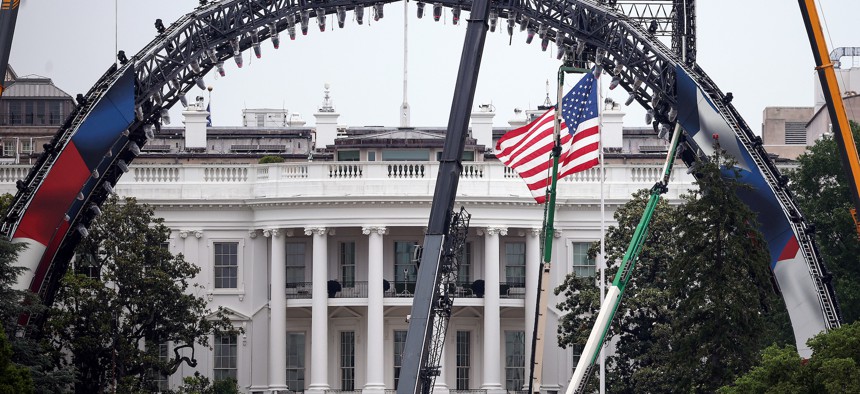
Construction continues for the upcoming UFC match on the South Lawn of the White House on May 26, 2026. The second Trump administration has placed political appointees at agencies that haven't had them in recent years. Kevin Dietsch / Getty Images





Federal oversight faces ‘structural conflict’ as political appointees enter IG offices
The 16 agencies that now have non-Senate-confirmed political staffers for the first time in 15 years include the IRS and Forest Service, according to a new report.

Along with increasing the number of political appointees in the federal government, the second Trump administration is also installing such officials at agencies that haven’t employed political staffers in recent history.
According to a report published on May 28 by the Partnership for Public Service nonprofit, there are 16 agencies and subagencies that had zero non-Senate-confirmed appointees between 2009 and 2024 that had at least one as of March 2026.
Some of the agencies include the Consumer Financial Protection Bureau, Forest Service, National Archives and the IRS, which has never before had non-Senate-confirmed political appointees.
“These trends reveal that the politicization of federal leadership is not simply intensifying — it is spreading,” wrote Partnership researcher Chris Piper. “In each case, political appointees are displacing or crowding out career officials whose expertise, continuity and institutional knowledge have been the foundation of effective agency operations and mission delivery.”
In particular, the Partnership flagged that there are two political appointees assigned respectively to the inspector general offices for the departments of Housing and Urban Development and Labor.
OIGs provide independent oversight of agency operations. Since at least 2009, according to the report, no other OIG had any non-Senate-confirmed political staffers.
“[OIG] credibility depends on operating free from the direction of the very officials they oversee,” Piper wrote. “A political appointee within an IG office, outside of the Senate-confirmed inspector general, does not merely break a historical norm — it introduces a structural conflict of interest into an institution whose effectiveness depends on independence.”
Good government groups have criticized the president for firing many IGs and replacing most of them with individuals who worked in the first or second Trump administration. The IG for the Labor Department — Anthony D’Esposito, a former GOP congressman — has also faced questions about actions he has taken while in the watchdog position seemingly to prepare for another political campaign, which could have violated ethics rules.
There also are political appointees for the first time at the Federal Labor Relations Authority and Nuclear Regulatory Commission. Both are examples of independent agencies that were created to have some degree of separation from the White House, but the Trump administration has sought to exert more influence over their operations.
The Partnership also emphasized that non-Senate-confirmed appointees have been assigned in “unprecedented numbers” to management offices, such as the Veterans Affairs Department Information and Technology Office and the Federal Acquisition Service under the General Services Administration.
“[U]nlike the career officials they displace, political appointees are unlikely to serve long enough to witness the consequences of the budget decisions they make, the technology investments they oversee or the procurement contracts they negotiate,” Piper wrote. “Political appointments in management functions also raise concerns about undue influence over decisions that should be made on the merits — including the awarding of contracts and the allocation of federal resources in ways that serve political rather than programmatic ends.”
The Partnership also complained that officials generally don’t have to disclose the specific work that non-Senate-confirmed appointees are performing.
“This lack of transparency is not unique to this administration. But it is more consequential when political appointments are reaching new corners of the federal government,” Piper wrote. “This administration has expanded political appointments into agencies and offices where they have not existed in at least 15 years. As a result, appointees are performing functions for which no clear policy-directing rationale applies and where the consequences of politicization may be slow to emerge and difficult to trace.”
The White House did not respond to a request for comment.
Earlier this year, the Trump administration finalized regulations for Schedule Policy/Career, a new job classification that would remove civil service job protections for as many as 50,000 government workers in “policy-related” positions. Critics argue that it will result in political appointees replacing career staffers while administration officials have insisted that federal employees will not be removed based on their political affiliations.
If you have a tip that can contribute to our reporting, Sean Michael Newhouse can be reached securely at seanthenewsboy.45 on Signal.
NEXT STORY: Federal employee NDAs aren’t new, but expanding them requires careful guardrails