
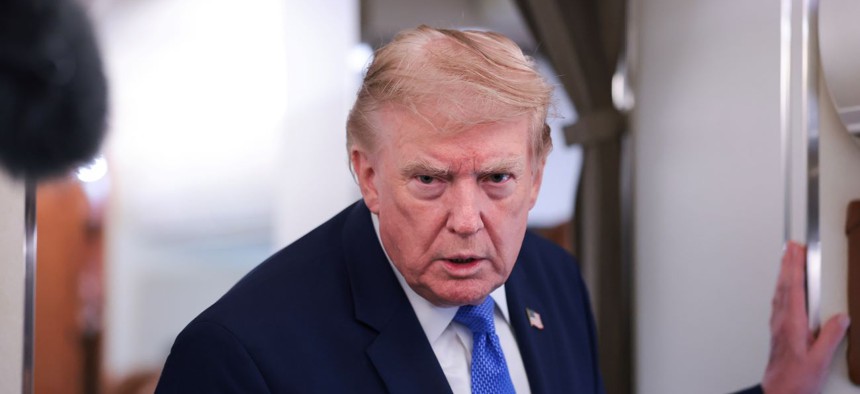
President Trump has until the end of August to formalize his plan for federal employee pay next year, or else much larger automatic increases will take effect. Anna Moneymaker/Getty Images




The state of play around the 2027 pay raise, or lack thereof
Thus far, neither chamber of Congress has put forth a plan that would override President Trump’s planned pay freeze for next year.

President Trump is expected sometime this month to issue a plan to freeze federal employee pay in 2027, though if last year was any indication, it may not be that straightforward.
When the White House published its fiscal 2027 budget proposal in April, the document, which normally lays out the administration’s pay plan for the following year, was silent on civilian compensation. The Office of Management and Budget later confirmed that Trump was in fact proposing “no pay increase” for 2027, while military service members would see between a 5% and 7% raise, depending upon their rank.
Trump now has until the end of August to formalize his alternative pay plan for next year; otherwise, much larger automatic increases in locality pay would take effect, due to a formula in the 1990 Federal Pay Comparability Act that has been criticized by presidents of both parties since its enactment.
Congress thus far has not taken action to overrule Trump’s pay plan. The House’s fiscal 2027 financial services and general government appropriations bill is silent on federal employee pay—effectively endorsing the president’s plan. And while the Senate has not yet published its draft of the FSGG funding bill, lawmakers in that chamber have proposed reducing the military pay raise to an across-the-board 3.6% raise as part of its proposed 2027 National Defense Authorization Act.
Democrats in both the House and Senate have called for a more fulsome raise of 4.1% on average next year, as part of their annual advocacy for the Fair Adjustment of Income Rates Act. Under that plan, civilian federal employees would receive a 3.1% increase in basic pay, coupled with an average 1% increase in locality pay.
While Trump is expected to formalize his plan for a pay freeze later this month, it’s not a sure thing. Last year, the president’s so-called “skinny” budget was also silent on federal employees pay, while OMB documents to agencies instructed them to plan for a pay freeze in 2026.
But ultimately, the president’s alternative pay plan enacted a 1% across-the-board increase in basic pay and no increase in locality pay for most workers. Feds in “law enforcement” fields were granted a 3.8% raise, in line with the increase afforded to military service members in 2026.
More changes to federal compensation could be in the offing in the coming months, as the Office of Personnel Management has signaled it plans to issue new regulations governing the locality pay system.
If you have a tip that can contribute to our reporting, Erich Wagner can be securely contacted at ewagner.47 on Signal.
NEXT STORY: Former feds have a new way to find their personnel files