

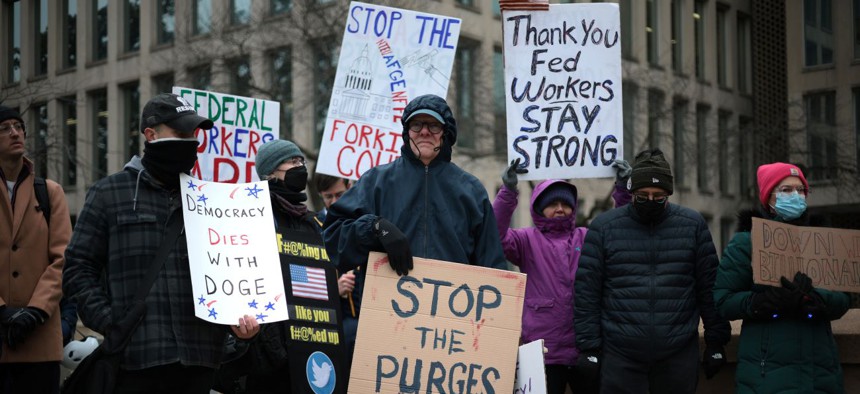
The Office of Personnel Management last week formalized the end of the governmentwide Federal Employee Viewpoint Survey, a move good government groups say will hurt agencies' ability to meet their mission. Photo by Alex Wong/Getty Images




OPM formally ends FEVS in favor of agency-specific surveys
Federal employees and good government groups warn the promulgation of smaller, shorter surveys means agencies will miss out on important information about the health of their organizations.

The Office of Personnel Management last week finalized regulations formally ending the governmentwide administration of the Federal Employee Viewpoint Survey, a move good government groups warn will hurt both transparency and agencies’ ability to improve themselves.
Earlier this year, OPM proposed “decentralizing” the annual survey of employee attitudes toward their job and agency leadership, after failing to conduct the survey in 2025—an apparent violation of federal law—purportedly over the need to strip diversity-related topics from the questionnaire and “refocus” it.
In a final rule published in the Federal Register Friday, the HR agency said that going forward, agencies are expected to conduct their own surveys each year and forward the data to OPM for publication. The regulations also cut the number of required questions each year from 16 down to 10, removing most questions pertaining to employees’ morale and workload and accentuating queries regarding whether poor performers are held accountable.
“In 2026, after serious consideration, OPM decided to discontinue the governmentwide administration of FEVS, as it was felt the survey had become a check-the-box activity and did not yield actionable insights sufficient to justify the cost and burden it imposed,” the rule states. “[FEVS] did not provide enough meaningful assessment as a general purpose, one-size-fits-all instrument, nor did it have enough actionable feedback or make a real impact for employees to be worthwhile.”
Experts have argued that this characterization bears little resemblance to how high-performing agencies have encouraged participation in the annual survey and utilized the results to boost engagement and performance in recent years.
The Partnership for Public Service, a good government group that has been critical of the Trump administration’s changes to the civil service, opposed OPM’s proposed rule changes. The organization conducts its annual Best Places to Work in the Federal Government—an endeavor OPM Director Scott Kupor has previously denigrated as a “vanity project”—based upon the FEVS and some of the questions deleted in last week’s regulations, and the group recently launched its second annual survey of federal workers after OPM canceled FEVS last year.
Jenny Mattingley, the Partnership’s vice president for public policy and stakeholder engagement, said the move away from a government-wide survey marks a shift from nearly two decades ago, when OPM found individual agency surveys made it too difficult to identify cross-agency trends or promising workplace practices.
“I think there’s an issue both about what can agency human capital offices and career leaders see about what’s going on in their agencies vs. at others, and a lot of the rules and best practices agencies follow in terms of engagement come from constantly learning from each other and helping each other out,” she said. “No one agency has the answer on how to do this, which is why having a government-wide benchmark and the Best Places to Work as something to strive for. It builds interest, understanding as well as political leadership buy-in.”
Stripping most questions related to employees’ morale or engagement with leadership could blind agency leaders to issues within the organization that could ultimately undermine customer service and mission delivery, she said.
“A lot of people, when they hear ‘engagement’ and ‘satisfaction,’ they think it’s a nice to have,” Mattingley said. “But there are lots of correlations, according to research in the private sector, between engagement and organizational productivity. It’s not just a nice to have, it’s not just about telework or work-life balance, they’re management tools in terms of recruitment, retention and ensuring employees have the ability to get their work done.”
While in its rule, OPM described FEVS as too costly, but Mattingley said she was concerned that moving to having each agency survey its workforce individually is just shifting costs onto agencies that are already struggling budgetarily. OPM has said it will continue to administer surveys on agencies’ behalf for a fee.
“It puts agencies in a conundrum—if agencies have to start paying OPM or a contractor for it, that’s a whole different resource constraint on agencies from doing it and doing it well,” she said. “It does raise the question of whether agencies are going to be able to do this in a meaningful way.”
At the Centers for Disease Control and Prevention, an email obtained by Government Executive announced that it would soon launch its Annual Employees Survey with just the 10 questions prescribed in last week’s final rule and taking an estimated five minutes to complete.
One employee expressed frustration at its newly limited scope.
“No questions on the agency as a whole,” they wrote. “No questions on whether employees feel like the agency is accomplishing its mission, no questions on competence of leadership, no questions on communication from leadership . . . This survey is lip service to a statutory requirement to gather meaningful employee feedback. It’s an absolute joke.”
If you have a tip that can contribute to our reporting, Erich Wagner can be securely contacted at ewagner.47 on Signal.
NEXT STORY: Musk is the target of a new Democratic bill to curtail political donations from federal contractors