
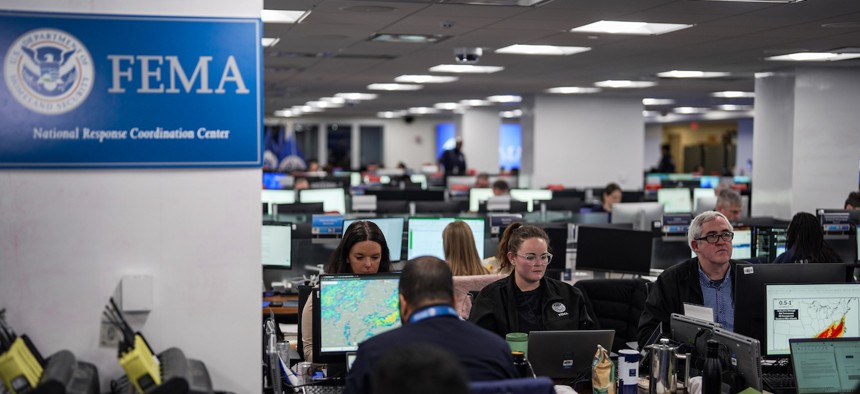
The much anticipated review of the Federal Emergency Management Agency called for a smaller footprint of the organization after a staffing assessment and a multi-year effort to shrink the workforce. Al Drago/Getty Images





FEMA should employ fewer staff and offer aid to fewer individuals, Trump’s council recommends
The changes come after the president proposed an overhaul, or outright elimination, of the disaster response agency.

The federal government would employ less staff to respond to disasters and offer fewer opportunities for assistance to those impacted by them under a new set of recommendations put forward on Thursday by a panel created by President Trump, which said state and local governments must assume a larger share of responsibilities after major storms and other emergencies.
The much anticipated review of the Federal Emergency Management Agency called for a smaller footprint of the organization after a staffing assessment and a multi-year effort to shrink the workforce. FEMA’s workload has ballooned well beyond its initial mission, the panel said, which has resulted in an overly bureaucratic system that discourages states, individuals and the private sector from taking on important tasks.
Members of the FEMA Review Council—led by Homeland Security Department Secretary Markwayne Mullin, Defense Department Secretary Pete Hegseth and assortment of 10 current and former elected leaders and emergency management officials—said at a meeting unveiling their final report on Thursday that their “north star” was shifting leadership of emergency response and recovery to state, local, tribal and territorial governments. Their recommendations will now go to President Trump—who created the council by executive order on his first week in office—for his review, though many of the most significant proposals would require legislative action.
The council’s other goals included making FEMA a leaner organization, emphasizing the role of the individual, accelerating federal assistance dollars and maximizing transparency of public dollars spent on emergency management.
State and local governments should not be relying on federal spending to sustain their programs, said Kevin Guthrie, executive director of the Florida Division of Emergency Management and a lead on the FEMA panel. States should only hire firefighters they can pay themselves after initial federal assistance, Guthrie said as an example, and they should partner with faith and nonprofit groups for initial debris removal.
“Federal assistance should only be reserved for truly significant events that exceed state, local, tribal and territorial capacity and capability,” Guthrie said.
The council proposed a radical overhaul of FEMA’s assistance to individuals after disasters. Survivors can currently qualify for any of 15 different categories of individual assistance after an emergency, including for child care, medical expenses or a funeral. Under the new proposal, FEMA would offer only assistance to those whose houses were completely destroyed. The new approach would create a more streamlined interaction for survivors, who council members said have often complained of overly burdensome and confusing paperwork. They would still be able to use the funds for other costs, such as medical expenses or funerals.
Under the Trump administration, many governments and advocacy groups have complained of slowed down dispersal of funds after a disaster due to added layers of review and staffing losses.
Madison Sloan, director of disaster recovery and fair housing for the nonprofit Texas Appleseed, told reporters after the council released its recommendations that disaster survivors "absolutely" want a more streamlined system, but said the proposals would "slash the help" that is available to them.
“If your major disaster need is medical or funeral expenses, or you lost the car, you need to get to work, there's no help for you if your home wasn't destroyed,” Sloan said.
The panel suggested FEMA raise the threshold for when disaster declarations are made, saying it has become artificially low and does not appreciate the capacity state and local governments maintain.
It also recommended an overhaul of how FEMA doles out money for rebuilding and disaster avoidance, saying those mitigation dollars are disbursed too slowly in the current system. Under a new framework, states would be able to quickly tap into a percentage of estimated disaster costs in two tranches. In addition, the public assistance program, which funds projects such as replacing damaged infrastructure, would shift from a reimbursement model to a block grant model. The existing system is “reactive” and “excruciatingly slow,” whereas the new structure would transfer funds to states within 30 days of a presidential disaster declaration.
The council was initially set to release its report last year but the plan was put on ice after intervention from then-DHS Secretary Kristi Noem. It reportedly included widespread cuts to FEMA’s workforce. The updated document did not call for any specific staffing level, though it did propose reductions. FEMA recently reversed course on some personnel cuts after it brought back hundreds of emergency responders whose contracts it previously declined to review.
The report would task FEMA with conducting a “strategic review of personnel requirements to determine appropriate staffing levels, primarily targeting the disaster workforce through program efficiencies and increased accountability.” The resulting “workforce adjustments” would take place over two-to-three years to allow the agency “to realize the efficiencies while reducing staff.”
FEMA would, under the proposal, also consider relocating its headquarters out of Washington and offloading some of its work to the Defense Department.
Will McDow, the Environmental Defense Fund's associate vice president for coasts and watersheds, said the council's findings failed to reflect the increasingly frequent and severe storms across the country.
“Slashing investments and functions of FEMA would shift enormous burdens onto states and communities and reduce government efficiency,” McDow said. “Instead of one centralized agency that can respond for all states, we would need 50.”
Sloan similarly suggested the proposals would leave gaps in the nation’s emergency response.
“There is a major shift of responsibility and costs to state, local, tribal and territorial governments, with no guarantee that there will be sufficient federal funding to meet those costs, or that states will be able to raise that money themselves,” she said.
If you have a tip that can contribute to our reporting, Eric Katz can be securely contacted at erickatz.28 on Signal.
NEXT STORY: Legislative proposal would eliminate contracting preferences for minority, women-owned businesses