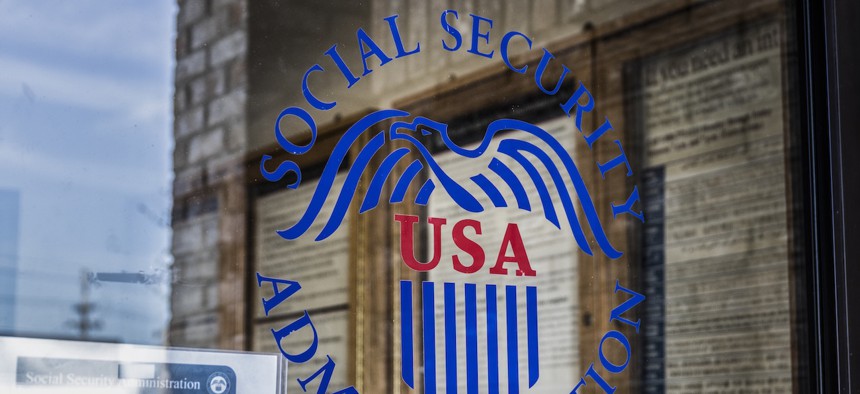
In recent months, the Social Security Administration has implemented a “badge in/badge out” system for measuring how many employees work at the agency’s various offices around the country. jetcityimage/Getty Images




SSA union fears field offices could shutter under new building occupancy law
The USE IT Act requires the General Services Administration to collect data on federal office occupancy rates, but Social Security employees worry the measure could wrongfully target understaffed but in-demand field office locations.

Officials with the nation’s largest federal employee union on Friday raised concerns that a 2024 law enabling the General Services Administration to offload federal property based on low occupancy rates could mistakenly target busy Social Security Administration field offices for closure.
In recent months, SSA has implemented a “badge in/badge out” system for measuring how many employees work at the agency’s various offices around the country. That’s part of the federal government’s broader effort to implement the provisions of the 2024 Utilizing Space Efficiently and Improving Technologies Act—USE IT, for short.
The USE IT Act requires federal agencies track the occupancy rates of their various buildings, with a goal of at least 60% occupancy. If a particular office consistently fails to hit that threshold, GSA is empowered to take steps to shrink that agency’s physical footprint.
GSA released its first tranche of federal office utilization data last month. Though the agency noted that there may be inconsistencies or inaccuracies in this initial release, it said no agency had hit the 60% occupancy benchmark between Jan. 12 and March 6.
AFGE Council 220 President Jessica LaPointe, whose union represents field office and teleservice center employees, told Government Executive that basing whether or not to offload an office solely on employee occupancy data could have unintended consequences at an understaffed agency like SSA. Without additional data, such as non-employee foot traffic or customer demand, a busy but understaffed could be erroneously targeted for closure.
“[If GSA makes property decisions just on employee occupancy rates] it’s not based on what the customer needs, it’s based on how many workers are left,” LaPointe said. “We saw with an office in southeastern Cleveland [in 2024] close organically, because they had too few workers to keep it open. They were going to consolidate it and send the remaining employees to surrounding areas until [then-Commissioner Martin] O’Malley stepped in and created details to move workers back into that area. We’ve already seen it happen organically, but now under this law and how [the Office of Management and Budget] is interpreting the law, this could be a real issue for communities.”
At the close of the Biden administration, staffing at the agency responsible for millions of Americans’ retirement and disability benefits was at a 50-year low; in 2025, the agency shed an additional 7,400 workers.
LaPointe said that currently, field offices in towns like Decorah, Iowa, Logan, W.Va., and Bloomsburg, Pa., have been temporarily closed for more than a year, not due to lack of demand but lack of staff. And some of SSA’s recent efforts to relieve high workloads at understaffed offices would not show up in the occupancy data submitted to GSA.
“Reassignments are only happening virtually, so the 2,000 workers who have been reassigned to help with field office work are still ‘badging in’ at headquarters, not the field offices,” she said.
Though SSA did not respond to a request for comment Friday, LaPointe said management has told her union that it is working to increase hiring in “distressed” areas. The agency’s fiscal 2026 appropriation includes $50 million for targeting hiring efforts, and President Trump’s fiscal 2027 budget proposal calls for the hiring of around 600 additional employees next fiscal year.
“If a full-time equivalent costs anywhere from $100,000 to $150,000 per worker annually, including pay, benefits and overhead, that’s about 300 more workers,” she said of the 2026 hiring money. “That’s the issue. Even if we do hire, we’re not hiring at a rate that would solve this crisis . . . This is a problem we need to fix through emergency appropriations, sustained hiring and support, and benefits and pay adjustments for the workforce. But in the meantime, until we can rectify that, we need to get an exemption from [the USE IT Act]."
If you have a tip that can contribute to our reporting, Erich Wagner can be securely contacted at ewagner.47 on Signal.