

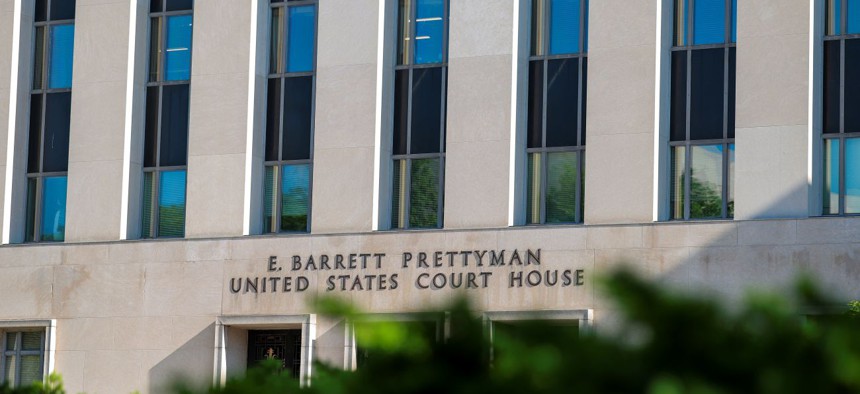
Attorneys for the National Treasury Employees Union told federal judges that a recent FLRA decision reinforces its argument that the semi-judicial agency cannot hear its legal challenge against President Trump's anti-union executive orders. Photo by Heather Diehl/Getty Images




FLRA ruling puts ball back in courts’ court on Trump’s union EOs
The National Treasury Employees Union said Wednesday that a recent Federal Labor Relations Authority decision supports its argument that it cannot seek redress through administrative channels.

The National Treasury Employees Union said Wednesday that a new ruling from a semi-adjudicative agency bolsters its argument in the fight over whether President Trump can strip wide swathes of the federal workforce of their collective bargaining rights.
Unions have been in protracted litigation over the question since Trump signed a pair of executive orders last year exempting most agencies from federal sector labor law under the auspices of national security. In total, the so-called ‘exclusion’ orders impacted roughly two-thirds of the federal workforce.
While the labor groups have succeeded in some instances of blocking the orders’ implementation at individual agencies, they have struggled to halt the initiative government-wide. In NTEU’s lawsuit, which has languished before the U.S. Court of Appeals for the D.C. Circuit since oral arguments were held last December, the three-judge panel has publicly grappled with the question of whether unions may directly challenge the executive orders’ legality in court, without first going through administrative channels like the Federal Labor Relations Authority.
The FLRA, which at the time of Trump’s orders was deadlocked due to his firing of former Chairwoman Susan Tsui Grundmann last year, initially responded to the edicts by placing cases involving the unions and agencies at issue in abeyance.
But in a 2-1 decision involving employee discipline at a U.S. Marine Corps facility in Twentynine Palms, Calif., Tuesday, the agency dismissed management’s appeal on grounds that it lacked jurisdiction, due to the Defense Department’s inclusion in the executive orders. It extensively cites the American Federation of Government Employees’ lawsuit challenging the edicts’ legality, in which a Ninth Circuit appellate panel overturned an injunction blocking their implementation, and stressed the decision does not weigh in on the orders’ legality.
“Importantly, the authority did not review the merits of [previous] presidential national-security determinations at issue in any of those cases before dismissing them,” the majority wrote. “Considering the factors mentioned above—including the pertinent precedent—the authority finds it appropriate to take this case out of abeyance at this time, and to dismiss the agency’s exceptions due to a lack of jurisdiction.”
Following the ruling, NTEU submitted a letter to the court Wednesday arguing that the decision reinforces its argument that requiring unions to first seek redress from the FLRA would be time-consuming and fruitless. And it noted that the union in that case could not appeal it if it wanted to, due to restrictions on which types of arbitration cases can be reviewed by circuit courts.
“The union in U.S. Marine Corps cannot challenge EO 14251’s validity in an appeal of the decision because the decision is not subject to judicial review,” wrote Paras Shah, NTEU’s general counsel. “An FLRA order ‘involving an award by an arbitrator,’ like U.S. Marine Corps, is not reviewable by a U.S. court of appeals ‘unless the order involves an unfair labor practice.’ . . . As this decision shows, no FLRA order dismissing a case for lack of jurisdiction will ‘include a substantive evaluation’ of an unfair labor practice.”
The FLRA case is unusual in that U.S. Marine Corps officials agreed with the FLRA that it lacked jurisdiction to adjudicate management’s appeal. And although the AFGE local technically won the case, it is unclear how it can ensure compliance with the arbitrator’s underlying award now that the union is no longer recognized.
FLRA Member Anne Wagner, the agency’s lone Democratic appointee, dissented from Tuesday’s decision, calling it premature, given the litigation surrounding the executive orders.
“I continue to believe that the most prudent course of action is to keep cases covered by the exclusion orders in abeyance until the litigation over those orders reaches a definitive conclusion—including any actions by the U.S. Supreme Court,” Wagner wrote. “Although the majority cites previous examples of the authority dismissing cases based on executive orders that excluded the relevant entities from the statute, the executive orders in those cases were not the subject of pending litigation.”