
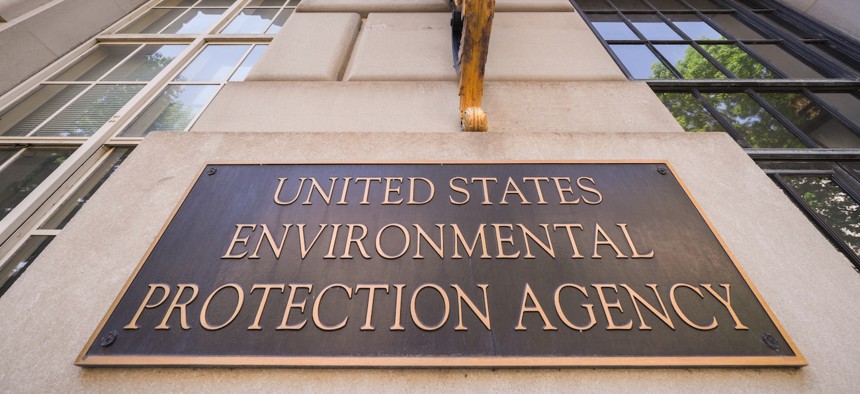
Around 15 workers, including seven employees still serving their one-year probationary period, were terminated in early October. J. David Ake/Getty Images





EPA workers fired over dissent letter appeal to MSPB
Only a fraction of the more than 130 employees who signed an open letter to EPA Administrator Lee Zeldin accusing the Trump administration of “recklessly undermining” the agency’s mission were ultimately terminated, purportedly because they worked in “public-facing” roles.

Half a dozen former Environmental Protection Agency employees, fired last month in the aftermath of an open letter excoriating agency leadership, on Wednesday appealed their removal to the Merit Systems Protection Board, alleging violations of their First Amendment rights and retaliation for their political beliefs.
Last June, nearly 300 EPA employees signed a “Declaration of Dissent” to Administrator Lee Zeldin, accusing the Trump administration of “recklessly undermining” the agency’s mission and promoting a “culture of fear” internally. The agency responded in July, suspending around 140 workers who signed the letter by name.
Ultimately, most targeted for retribution were issued letters of reprimand or forced to take two weeks’ unpaid leave. But around 15 workers, including seven employees still serving their one-year probationary period, were terminated in early October, shortly after the start of the 43-day government shutdown.
According to a termination notice published by Public Employees for Environmental Responsibility, which is helping to provide legal counsel the six employees appealing to the MSPB, those targeted for firing held public-facing roles that require “alignment with the agency’s communication strategies.”
“The agency is not required to tolerate actions from its employees that undermine the agency’s decisions, interfere with the agency's operations and mission, and the efficient fulfillment of the agency’s responsibilities to the public,” the notice states. “As an EPA employee, you are required to maintain proper discipline and refrain from conduct that can adversely affect morale in the workplace, foster disharmony, and ultimately impede the efficiency of the agency.”
But Joanna Citron Day, general counsel for PEER, said that rationale doesn’t line up with federal personnel policy, which allows employees to speak on matters of public concern, provided they stipulate that they are doing so in a personal capacity and not on behalf of their agency.
“The fact that they’re public-facing is an excuse that they’re using to say that these people somehow have more influence on the agency’s reputation, when in fact, EPA’s current leadership is doing a quite phenomenal job on their own of getting bad press for running it into the ground and abandoning EPA’s fundamental mission of protecting public health,” she said. “It’s bogus.”
The workers challenging their termination have between one and four decades of experience at EPA, including a biologist, epidemiologist, attorney and a hazardous materials cleanup coordinator. Their MSPB appeals allege violations of the First Amendment, illegal retaliation for perceived political affiliation, arbitrarily harsh and inconsistent punishment compared with other signatories of the dissent letter, and that they were fired without cause.
Justin Chen, president of the American Federation of Government Employees Council 238, stressed that the fired workers—and their less harshly punished colleagues—did “absolutely nothing wrong” in signing the letter. He said the effort to crack down on employees who dare to speak out against leadership feels part and parcel with the Trump administration’s other efforts to remake the federal workforce in the president’s image.
“We’re concerned at the overall state of things; the direction this political administration is trying to take things seems to be to make sure that only sycophants and unqualified individuals are running these agencies, and not the professional career civil servants who know exactly what they’re doing and how to act in an appropriate manner to serve the public.”
While the union stands behind the disciplined and fired employees, Chen acknowledged that it is more difficult than ever to labor groups to mount an effective defense. Like dozens of other agencies, EPA terminated most of its union contracts in the wake of President Trump’s executive orders stripping two-thirds of the federal workforce of their collective bargaining rights.
“The fact that we no longer have a recognized collective bargaining agreement, that makes it incredibly challenging,” he said. “It takes our main legal recourse—filing grievances against management—away from us. And on top of that, this administration has completely hampered organizations like the MSPB and Office of Special Counsel so that these institutions that were meant to act in a relatively quick fashion are essentially frozen.”
Share your experience with us: Erich Wagner: ewagner@govexec.com; Signal: ewagner.47
NEXT STORY: HHS adds new conditions to telework for employees with disabilities