
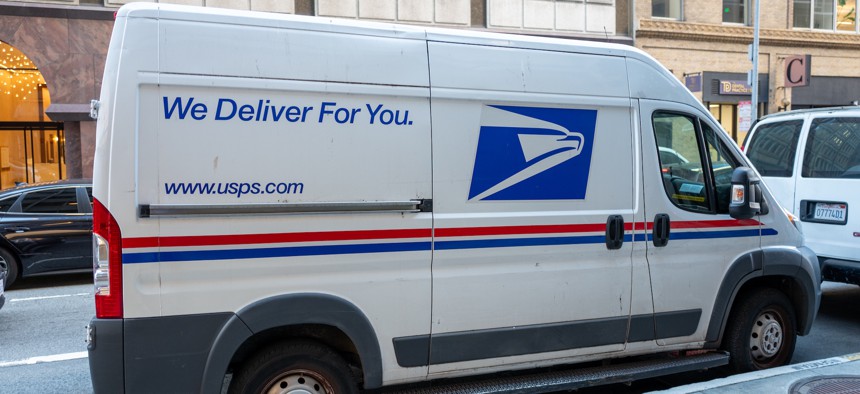
The Postal Service has historically served as a channel for federal agencies to provide services, such as passport processing. Smith Collection / Gado / Getty Images




Agency partnerships are a potential financial lifeline for USPS, watchdog reports
Some of the inspector general’s suggestions included providing biometric services at more locations and working with state and local governments.

With the prospect of running out of money by fall 2026 looming, the watchdog for the U.S. Postal Service recently laid out how the agency could partner with other government departments to expand access to services and shore up its finances.
“Although the additional revenue government services may yield is uncertain, they could contribute to the bottom line and meaningfully advance USPS’s role as essential public service infrastructure,” the USPS inspector general wrote.
For example, investigators highlighted that USPS could expand the number of facilities providing FBI biometric identity verification services (e.g. taking of fingerprints). They reported that roughly 30.4 million people, 9% of the U.S. population, live more than an hour away from a post office offering these services, which can be needed for employment or international travel background checks.
The OIG also emphasized an ongoing pilot program between USPS and a private company to offer TSA PreCheck enrollments and renewals at post offices.
“If the Postal Service was able to work with the TSA to provide the service at the 1,250 postal locations already equipped with biometric hardware, USPS would improve access for applicants, in particular in rural areas where private vendors lack a physical presence,” investigators wrote.
The Federal Communications Commission also suggested that postal facilities could lease their roofs for 5G and broadband towers in order to expand access, especially in rural areas. This would not be wholly unfamiliar territory for USPS, as the OIG noted that the postal agency already leases space for communications infrastructure at around 60 locations.
Nonpostal government services in fiscal 2025 yielded $387 million for USPS, about 0.5% of total operating revenue. Of that amount, 80% came from passport processing, which post offices have been offering in conjunction with the State Department since the 1970s.
The OIG stressed that USPS is not limited to federal partnerships. The Postal Service Reform Act of 2022 authorized the post office to work with state, local and tribal governments. Despite this, officials have no interagency agreements with these governments and have not conducted outreach.
State agencies in Texas, for example, told the OIG that postal facilities could act as “multi-agency hubs” to “bridge service gaps in remote areas where citizens may currently travel over 100 miles for state services.”
Investigators did note that USPS between 2021 and 2022 partnered with the California Department of Motor Vehicles on a pilot program to install DMV kiosks in post offices for vehicle registration renewals. They wrote that it was not continued due to “insufficient demand.”
The OIG recommended that USPS establish a strategy with steps to identify and gauge opportunities to expand services across different levels of government. USPS officials agreed with the recommendation and said they would “formalize and refine” past similar efforts into a singular roadmap.
Postmaster General David Steiner has expressed support for creating more partnerships with other agencies. He recently testified that USPS could run out of money as soon as fall 2026.
If you have a tip that can contribute to our reporting, Sean Michael Newhouse can be reached securely at seanthenewsboy.45 on Signal.
NEXT STORY: Newest inspector general nominees show shift from overtly political backgrounds