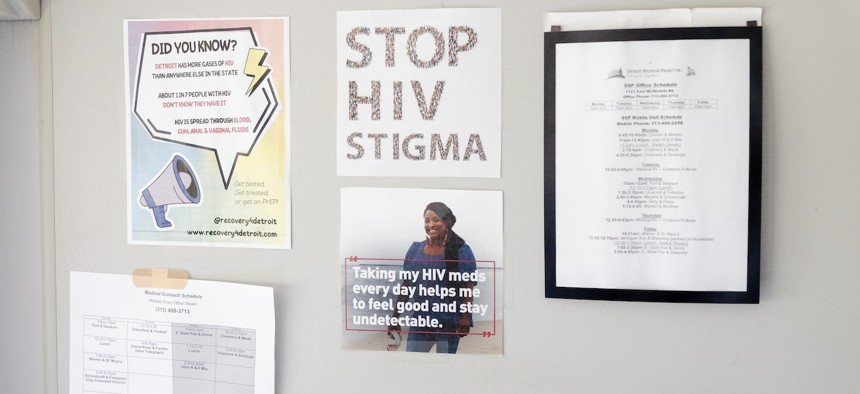
Health flyers educating about HIV prevention in a mobile unit at the Detroit Recovery Project, a nonprofit helping communities grappling with drug and alcohol addiction, as well as other marginalized groups on Aug. 5, 2025 in Detroit. Sylvia Jarrus for The Washington Post via Getty Images




CDC shifts HIV prevention funds away from groups tackling this work
The health agency will route HIV prevention grants through state and local health departments instead of directly funding community-based organizations.
The Trump administration will not reauthorize millions of dollars in HIV prevention funding that used to go directly to community-based groups, opting instead to redirect that money to state and local health departments.
The money that the Centers for Disease Control and Prevention previously distributed to community-based HIV prevention organizations will now go to states, which will decide whether or not to fund the CBOs. Roll Call first reported on these changes in federal HIV grants.
CDC’s National Center for HIV, Viral Hepatitis, STD, and Tuberculosis Prevention (NCHHSTP) told staff in an email Tuesday that it will not renew a federal cooperative agreement supporting “Ending the HIV Epidemic in the U.S. through Community-Based Partnerships,” a stream of federal funding that supports dozens of organizations.
CDC employees and nonprofit groups said these changes will result in more administrative costs and will take longer for federal funds to reach community-based groups carrying out HIV-prevention work.
The CDC, in a related funding announcement from December 2020, wrote that “CBOs are uniquely positioned to complement and extend the reach of HIV prevention efforts implemented by state and local health departments and education agencies.”
“They support the optimization of services across public, private, and other community-based organizations to achieve objectives of increased identification of HIV diagnoses, referral for pre-exposure prophylaxis (PrEP) and non-occupational post-exposure prophylaxis (nPEP) services, earlier entry to HIV care, and increased consistency of care,” the agency wrote.
Department of Health and Human Resources Press Secretary Emily Hilliard said in a statement that “CDC remains committed to supporting HIV prevention efforts nationwide, including the critical work of community-based organizations.
“As CDC streamlines HIV prevention funding through health departments, local decision-making will remain central to combatting HIV, ensuring that local data inform local strategies and interventions,” Hilliard said. “CDC will continue to support HIV testing, diagnosis, and linkage to care, expand access to PrEP, and help people living with HIV achieve and maintain viral suppression.”
A CDC employee told Government Executive said that the agency is reverting back to an old model of awarding federal grants that wasn’t as effective at getting funding to the communities hardest hit by HIV.
“The result is more overhead cost for the states, which means less money that ultimately ends up with the CBOs for HIV prevention,” the CDC employee said. “A lot of money gets lost going down to the CBOs, and it helped with CDC being able to coordinate directly with them.”
A second CDC employee said that under this new funding model, state health departments would subcontract these community-based organizations, “leaving gaps in oversight and the loss of technical support provided directly from CDC to CBOs.”
“This is a serious attack on communities, as CBOs are on the boots on the ground for HIV work and losing them would be a major loss,” the second CDC employee said. “Many of the CBOs are run by folks with not only expertise but lived experience – which is critical in the HIV space given trust and stigma."
The second CDC employee said that in the interim, “many CBOs will either be shut down completely or have to lay off staff.”
“Local politics will play a much larger role in what happens with the CBOs [and] if they get funding,” the employee said
CDC employees said the agency was previously planning to renew this federal grant funding for another five-year cycle starting in fiscal 2027. Save HIV Funding, a coalition of over 150 organizations and advocates, said in a statement Monday that community-based organizations currently receiving these awards were provided a three-month extension through September 2026, but have now been informed that a new funding opportunity will not be released.
Jeremiah Johnson, the executive director of PrEP4All and co-founder of the Save HIV Funding campaign, said that some impacted organizations which have spent decades building relationships with communities hardest hit by HIV may have to lay off staff or shut down “if this critical funding stream is discontinued or altered beyond recognition.”
“As we have already seen too many times in the past year, when we lose critical CDC funding and infrastructure, we see more illness and associated healthcare costs in our communities,” Johnson said.
More than 1.2 million Americans are currently living with HIV, according to HIV.gov
If you have a tip that can contribute to our reporting, Jory Heckman can be securely contacted at jheckman.29 on Signal.
NEXT STORY: Homan says ICE officers will wear body cameras during traffic stops