

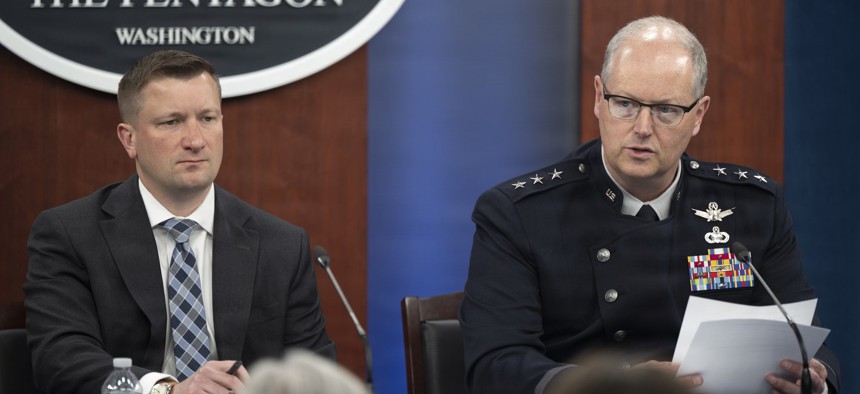
Jules W. Hurst III, who is performing the duties of Pentagon comptroller/chief financial officer, and Lt. Gen Steven P. Whitney, a Joint Staff director, brief reporters on DOD's 2027 budget proposal at the Pentagon on April 21, 2026. U.S. Navy Petty Officer 2nd Class Carson Croom





Space Force scrambles to repair workforce as massive budget increase looms
The service is trying to recruit at a record pace even as Pentagon officials insist civilian departures didn't hurt acquisition.

The Trump administration, which last year stripped the Space Force of 14 percent of its civilian workers, now wants the service to handle a budget more than twice as large.
The service’s 2027 budget request of $71.1 billion—way up from the $31.6 billion allocated in the current fiscal year—includes boosts for new space-based technologies and weapons in line with President Donald Trump’s “space superiority” executive order.
The administration official who is temporarily handling the duties of the Pentagon’s chief financial officer conceded that it’s a tall order.
“One of the major challenges for this budget is to be able to obligate dollars in a timely manner, because it's such a large increase,” said Jules W. Hurst III, who is performing the duties of the Under Secretary of War (Comptroller)/Chief Financial Officer.
But Hurst, a former Ranger-turned-legislative aide for House Speaker Mike Johnson, R.-La., downplayed the effects of the hastily implemented workforce cuts.
“We haven't been taking away workforce from areas that are involved in critical efforts like the [Defense Autonomous Working Group] or, you know, space acquisition, which is where a lot of this money goes,” he said in a Tuesday press briefing at the Pentagon.
In fact, Space Systems Command—the branch’s acquisitions arm—lost about 10 percent of its workforce in the wake of policies ordered by Defense Secretary Pete Hegseth.
Service officials were already talking about the impending acquisition crunch last fall.
“We have a looming increase in acquisitions coming down the pike, and so that presents us with a really difficult situation of where we need to double down on our acquisition workforce, our acquisition training. We are in a situation where we barely have enough acquirers to do all of the work that we have now,” Maj. Gen. Stephen Purdy, acting assistant Air Force secretary for space acquisition and integration, said Nov. 20 at a Center for Strategic and International Studies event.
Now, the service is struggling to rehire people to fill the gaps.
Lt. Gen. Philip Garrant, who leads Space Systems Command, told reporters at the Space Symposium conference in Colorado last week that he's faced with “a really challenging goal” to hire 100 civilians a month following the large number of departures.
“We've never hired that many people in a month,” said Garrant, who added that the most the command has hired in one month is 66 people. “It's really to get the workforce in place to execute all this funding that's coming our way.”
Garrant added that some of that has been “backfilling” positions from the Deferred Resignation Program. Other roles can’t be replaced because the service permanently lost those billets.
Of the $71 billion for the Space Force’s 2027 budget request, about $38 billion is for research, development, testing and evaluation initiatives. Nearly $10 billion would be for procurement of new technologies.
Space Force Lt. Gen Steven P. Whitney, the Joint Staff’s director of force structure, resources and assessment, told reporters that the new request supports a wide range of initiatives tied to Trump’s executive orders.
Whitney said it includes 31 national security space launches, $13 billion dollars to develop and field missile warning and tracking capabilities, development of two new GPS satellites and their supporting infrastructure, $5.9 billion for satellite communication systems, $7.7 billion for Airborne Moving Target Indication capabilities, and a $3.1 billion investment in the military’s next-generation space data network, which is tied to Trump’s sprawling Golden Dome missile defense program.