
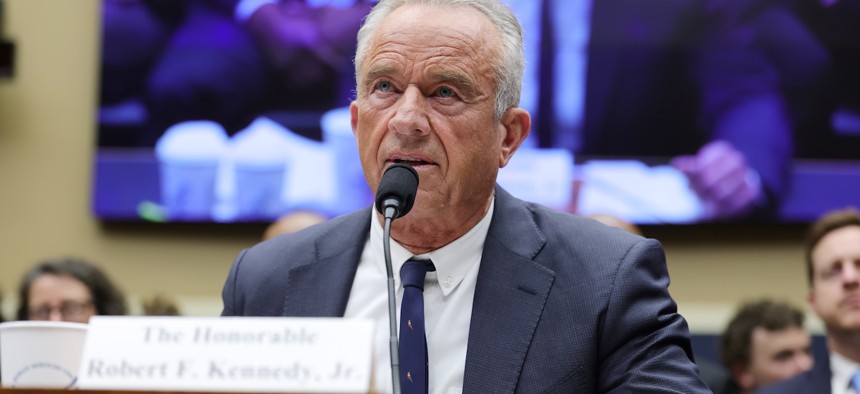
Health and Human Services Secretary Robert F. Kennedy Jr. testifies during a hearing to discuss HHS’ fiscal year 2027 budget request with the House Committee on Energy and Commerce subcommittee on April 21, 2026 in Washington, D.C. Anna Moneymaker/Getty Images




RFK: Cuts at HHS haven’t led to problems, but we’re hiring 12,000 new employees
"Nobody in the agency wants to cut these programs," Kennedy said, suggesting instead they were required by the White House.

The Health and Human Services Department is adding back a majority of the positions it slashed last year, with the head of the agency telling lawmakers on Tuesday the hiring spree is necessary to conduct its work.
Secretary Robert Kennedy made the comments despite also telling a panel of the Senate Appropriations Committee there was no degradation in the quality of service after HHS cut 20,000 employees in 2025. The department pushed out the employees because it had grown too much during the Biden administration, he said, though it is now going through a “rightsizing.”
“I do not,” Kennedy said, when asked if HHS had suffered in any way from last year’s staffing cuts. “We are now rightsizing. “We're in the process of hiring 12,000 to make sure we have people to do every job.”
HHS issued 10,000 reductions in force last April and cut an equal number of employees through various incentives and attrition programs. It has since hired back a small fraction of those it laid off. Some of those who remain laid off are still seeking reversal of the RIFs through various lawsuits.
The secretary suggested the cuts were necessary not just because of previous growth, but also due to HHS’ failures. Chronic disease had increased in the United States for an extended period, he said, which demonstrated the department required new staff.
Federal agencies are statutorily prohibited from hiring staff to fill positions previously filled by employees who were laid off. Legal experts warned ahead of the RIFs that using them to get rid of specific employees while filling their roles with new hires would enable those laid off to successfully challenge their removals.
“That is an appeal right there. That is an easy one to write,” Stephanie Rapp-Tully, a federal employment law attorney, told Government Executive ahead of the HHS cuts last year. “One of the triggers of ‘this isn't really a RIF, this is something else’ is when you hire somebody immediately into that position. The idea of a RIF is that it's an elimination of a role, not a person.”
Kennedy did not specify where exactly his department is now looking to grow. HHS currently has hundreds of jobs posted, focused primarily on the Centers of Medicare and Medicaid Services, Health Resources and Services Administration, the Food and Drug Administration and the Centers of Disease Control and Prevention. All of those components laid off staff last year.
Kennedy indicated he did not want to implement cuts at HHS at all, but the directive came down from the White House to do so. In its fiscal 2027 budget proposal, the department proposed cutting its budget by 12%. That represented a far smaller suggestion than the department put forward for fiscal 2026, when it proposed a cut of 25% that Congress largely ignored.
“We were told we need to tighten our belt at this agency,” Kennedy said. “Nobody in the agency wants to cut these programs.”
In a separate hearing earlier on Tuesday, Kennedy told members of the House Energy and Commerce Committee that “all of these cuts are painful,” but necessary to address the federal debt. Still, he acknowledged the final decision on spending at HHS rests with Congress.
“If you fund the programs, I'll spend the money.” the secretary said. “It's Congress' choice about whether to do it or not. It's not my choice. But we gave you a proposed budget that does what the president wants, which is to have broad cuts.”
Kennedy said that his department had made mistakes, such as when it implemented sweeping cuts to grants at the Substance Abuse and Mental Health Services Administration, only to walk them back a day later. Such errors may occur again in the future, he said.
“I can't tell you that a mistake will never happen again,” he said.
While HHS’ move to regrow the department closer to its staffing total from just before President Trump took office is likely to appease lawmakers across both parties who had criticized the moves, they warned he cannot quickly reverse course.
“Mr. Secretary, you're presiding over of one of the most consequential departments within the federal government,” said Rep. Frank Pallone, D-N.J., “and this is no small job, but unfortunately, your actions are dangerous to health care in our country, and it's going to take decades to repair the damage that you've done.”
If you have a tip that can contribute to our reporting, Eric Katz can be securely contacted at erickatz.28 on Signal.
NEXT STORY: Contractors sue to block Trump’s federal DEI executive order