
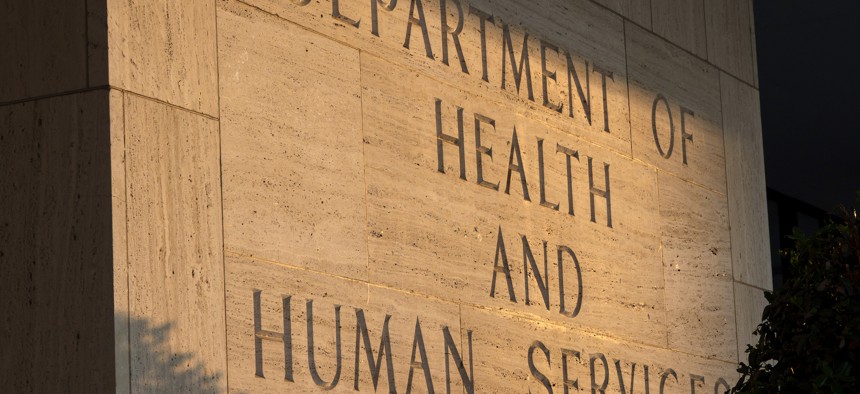
The Health and Human Services Department in May 2025 fired 300 individuals who were hired under Schedule A and had between one and two years of federal service. Kevin Carter / Getty Images



A hiring rule meant to help people with disabilities get federal jobs instead left them more vulnerable to DOGE mass firings
Several fired Schedule A employees who spoke with Government Executive say they’re still struggling to find new full-time employment after losing their federal jobs.

At the beginning of President Donald Trump’s second term, as part of the effort to slash the number of federal employees, his administration fired thousands of newly hired and promoted agency staffers who were still in their probationary periods. Such workers have weaker civil service job protections.
While the probationary period for a new federal employee is typically one year, it’s up to two years for those hired under Schedule A — a mechanism for agencies to bring on workers with a “severe physical disability, a psychiatric disability or an intellectual disability.”
Government Executive spoke with multiple individuals hired under Schedule A who were fired in 2025 between their first and second years of federal service. Some of the people interviewed feel they might still have a job if they did not have a disability or had been recruited by an agency through a non-Schedule A pathway.
“These are the employees that got affected. Why? How did it make a difference?” said one such worker at the Health and Human Services Department who was fired about a month before the end of their two-year Schedule A probationary period. They preferred to be unnamed because they are pursuing legal action. “To me, it's important for people to know. It may not make a difference to me, but if other people were to find out and see these were the impacts — that's a pretty large-scale thing.”
‘An extra punch’
Christa Reynolds had just completed her first year as a National Institutes of Health employee when she was caught up in the mass probationary firings as a Schedule A hire. Despite being a new federal staffer, she had worked at the agency for eight years prior as a contractor.
“I feel like we were doing really good work that was helping people and making a positive difference,” she said. “I know that's really corny, but I feel like it's important to have a mission and a reason to do your work instead of just wanting to get a paycheck, which is also very important.”
Before she was fired, Reynolds said that she worked on analyzing the distribution of agency grants and updating “hard-to-use [web pages] that were made in like 2000.” The Trump administration recently launched an initiative to improve the design of government websites.
While Reynolds was initially let go in February 2025, she was brought back on paid administrative leave due to court orders blocking the mass probationary firings. Ultimately, however, her position was terminated in May 2025 after those orders were overruled.
“I had been hoping that I’d be able to be brought back,” she said. “It also felt like an extra punch that I would have been back if I had not been hired on Schedule A.”
Since losing her job nearly a year ago, Reynolds has started a part-time contracting position but said that it’s been difficult to find full-time employment.
“The hard thing is finding something that feels comparable," she said. “A lot of jobs that I've applied for would be a huge pay cut or don't include benefits and then other jobs just feel really boring.”
Similarly, the employee who is pursuing legal action over being fired during their Schedule A probationary period said they have struggled to find a new job. And they emphasized that they don’t live in the Washington, D.C., area.
“There's a lot of people searching, especially in my hometown, there's a lot of people searching for work, so it's been difficult,” they said. “Still looking, but nothing has come of it.”
‘I was disgusted’
Based on a Government Executive analysis of federal workforce data from the Office of Personnel Management, HHS in May 2025 (the month that department officials formally fired many probationary employees) terminated nearly 1,400 employees with fewer than two years of federal service. Of those, 300 were individuals hired under Schedule A who had worked at the agency for at least one but fewer than two years.
Janice Lintz — a hearing loss disability advocate who worked at the Housing and Urban Development Department between 2023 and 2024, and who was hired under Schedule A herself because of a learning disability — said she was “disgusted” when she realized that more federal employees with disabilities could be impacted by the mass probationary firings because of the longer Schedule A probationary period.
She was frustrated, in particular, because she flagged the issue in 2024 to Jeff Zients, former chief of staff under President Joe Biden, who she unexpectedly met on a plane while traveling to her daughter’s wedding.
“If [the Biden administration] had changed the two-year [Schedule A probationary period] to one year, so many people with disabilities’ jobs would have been saved,” she said. “But they didn’t.”
Lintz argued that the additional year of probation for Schedule A hires is an unfair practice that disadvantages people with disabilities.
“Seriously, if someone can't tell whether someone's working in a year versus two years, then the issue is more with them than the person being hired,” she said. “If you're using someone effectively, you can tell in a year. I don’t really understand how an additional year sheds any further information.”
Neither HHS or OPM responded to requests for comment.
If you have a tip that can contribute to our reporting, Sean Michael Newhouse can be reached securely at seanthenewsboy.45 on Signal.
NEXT STORY: OPM wants federal workers’ medical records