
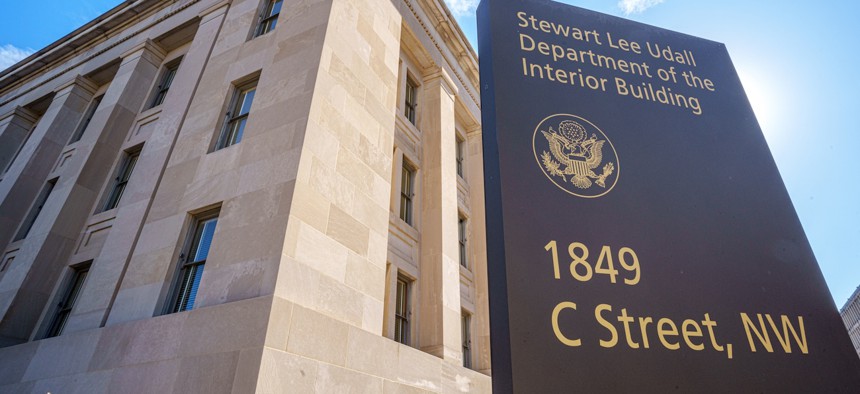
Recalled Interior Department employees will take on slightly different roles. J. David Ake/Getty Images




The Trump administration paid these employees not to work for more than a year. It just called them back
Some employees sidelined for their diversity and inclusion jobs received a one year, stress-ridden sabbatical, but are now returning to similar jobs.

In February 2025, about a month after President Trump began his second term in office, the Interior Department notified a few dozen employees that it was involuntarily placing them on paid leave and they were no longer permitted to conduct any government work.
They would remain in that status for more than a year. They helped out at their kids’ schools, completed home projects and exercised more, all while collecting a paycheck, but they could not engage in official duties.
Earlier this month, those employees—who Interior targeted for their previous work on issues related to diversity, equity and inclusion—returned to their jobs. One year later, it asked those who had not left the agency to come back.
Around three-dozen Interior employees were subjected to administrative leave last year, according to documents obtained by Government Executive, with jobs ranging from equal employment specialist to program analyst to diversity and inclusion officer. The sidelining of the workers followed executive orders President Trump signed on his first two days in office prohibiting DEI work in the executive branch and subsequent guidance from the Office of Personnel Management directing agencies to identify and, eventually, lay off all employees who engaged in it.
They were recently recalled in a memorandum from Rachel Borra, Interior’s chief human capital officer, in what amounted to a management-directed reassignment as the employees will take on slightly different roles.
“This reassignment is a management-directed action and is being taken to promote the efficiency of the service,” Borra told the employees. “Your reassignment is due to necessary updates to your position and job functions in support of the department's priorities.”
Employees subject to the year of idling said they have felt a “huge array of emotions” over that last 12 months.
“It was hysteria and anger,” said one Interior employee who recently returned to work when they found out about the administrative leave. “Very raw.”
They added that they worked through Trump’s first term without seeing any significant disruption, so the aggressive actions in his second term came as a shock. The employee expected to be subject to a reduction in force, as OPM had called for in its January 2025 guidance, and decided to stay put to collect any associated severance and unemployment. All the while, they remained hopeful that they would be able to return.
“I do really like my job,” the employee said. “The mission is very important to me.”
Interior has at multiple points been on the verge of implementing sweeping RIFs across its workforce, only for various court rulings stemming from lawsuits delaying those efforts at the 11th hour. The department no longer faces restrictions on layoffs, but the reductions appear to have been put on the back burner.
An Interior spokesperson declined to say why employees were not subject to RIFs as OPM directed, nor would they say exactly how many workers have returned to the department.
“The department made the choice to bring these employees back to work to focus on other, non-DEI related tasks,” the spokesperson said. “To be good stewards of taxpayer money, it was common-sense to repurpose these employees to carry out the department's mission. We are proud to say the department will no longer push a woke agenda like DEI initiatives which were designed in the previous administration to divide America.”
In the intervening year, employees who did not seek other employment frequently felt like they were on the verge of losing theirs.
“The year has been marked with depression and anxiety,” the employee said. “We would hear rumblings that something would happen ‘soon’ but that would be said several times and nothing would happen.”
The Trump administration planned to target nearly 600 employees across government on administrative leave because they worked on DEI or environmental justice issues, according to documents obtained by The Washington Post last year. Many of those employees have since faced RIFs or accepted incentives to voluntarily leave their jobs. A group of impacted workers subject to those layoffs are currently suing the government for unlawfully targeting them, in what they say violates RIF procedures.
The DEI and environmental justice employees represent a small slice of those the Trump administration has placed on extended paid leave this year. As part of its deferred resignation program, more than 150,000 employees accepted offers to not work for six months while on administrative leave and receiving full pay and benefits. Agencies placed tens of thousands of recently hired or promoted employees on administrative leave after seeking to fire them, with court injunctions blocking the immediate terminations. Most of those employees were eventually brought back to work, with OPM Director Scott Kupor recently telling Government Executive only around 7,000 federal workers were fired as part of the probationary period purge.
When it conducted mass layoffs, the Health and Human Services Department informed some of its top career senior executives it would reassign them to remote locations in the Indian Health Service. Nearly a year later, however, those employees remain on administrative leave.
Following reports of widespread abuse of administrative leave, Congress in 2016 passed a law that placed 10-day caps on its use. OPM did not issue regulations to implement the law until 2024, however, and it only applied the cap to employees actively under investigation. Upon taking office, Trump’s OPM paused enforcement of that regulation and encouraged agencies to use administrative leave as they implemented restructurings.
While employees at Interior have returned to similar roles, they now have a new reporting structure: the department has consolidated its human resources and other administrative functions away from individual bureaus and into Secretary Doug Burgum’s office. Borra, Interior’s human resources chief, last week sent a memo to staff encouraging them to notify the department of any DEI activities still taking place within the agency.
The recently returned Interior employee said while they are excited to be back, they are apprehensive about rejoining the workforce after so much time away.
“I’m also feeling like I’ve had a major brain drain the past year and like I have so much to relearn,” the employee said.
Share your news tips with us: Eric Katz: ekatz@govexec.com, Signal: erickatz.28
NEXT STORY: MSPB relinquishes jurisdiction over some federal worker appeals