

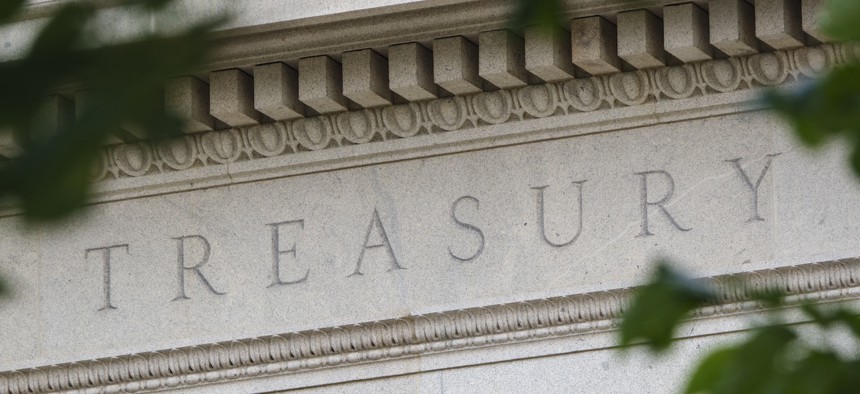
The Treasury Department’s Office of Financial Research informed staff earlier this month that it would institute reductions in force in the coming weeks, after which the office will have shed about 64% of its workforce since last January. Kevin Carter/Getty Images





A federal office designed to stave off the next financial crisis is being dismantled by the Trump administration
Upcoming layoffs at the Treasury Department agency will result in an overall workforce reduction of 64%.

The Trump administration is looking to lay off staff—after already pushing out nearly half of the workforce—at a small federal office with a daunting mission: providing analysis to stave off the next financial crisis.
The Treasury Department’s Office of Financial Research began President Trump’s second term with 196 employees. It now has about 100 and is looking to get down to 70, according to a current and former employee and documents obtained by Government Executive. OFR leadership informed staff earlier this month that it would institute reductions in force in the coming weeks, after which the office will have shed about 64% of its workforce since last January.
“I think it’s scary and concerning,” said one employee still remaining at OFR. “We are already a small office but we have people who are focused on a number of different areas…that are crucial for the functioning of the U.S. economy.”
Trump previously laid off dozens of OFR staff in his first term, though staffing was slowly rebuilt under the Biden administration.
Congress initially stood up the office as part of the 2010 Dodd-Frank Act to collect data and publish analysis related to potential risks to the financial sector and the U.S. economy. It reports to the Financial Stability Oversight Council, a separate entity within Treasury made up of various regulators in government.
Congressional Republicans sought to essentially eliminate OFR entirely as part of last year’s One Big Beautiful Bill Act, saying the office was duplicative and FSOC can conduct its own research. The Senate parliamentarian ultimately ruled the provision could not be included in the bill due to the mechanism lawmakers were using to pass it.
Congress created OFR in the wake of the Global Financial Crisis to address the lack of data that precipitated it. Last June, a group of more than 50 former Federal Reserve chairs, other former government officials and academics released a letter in support of OFR, noting it fills critical research gaps and offers key insights into economic risks.
“History shows that financial crises have high socio-economic costs and that the economic recovery from such crises tends to be protracted,” they said. “Defunding or significantly downsizing the OFR and its financial data and analytics would be a mistake, particularly so given today’s elevated macro-financial uncertainties.”
Democrats in Congress similarly said the moves were ill-advised.
“As risks emerge in the financial system and cracks in credit markets spread, the Trump administration is gutting the office designed to evaluate financial risks in a giveaway to Wall Street,” Sen. Elizabeth Warren, D-Mass., the top Democrat on the Senate Banking Committee, told Government Executive. “This is just the latest move by President Trump and his financial regulators to undermine financial stability and pave the way for another crash.”
OFR management first told employees of its layoff plans early last year before offering multiple rounds of “deferred resignation” that enabled employees to sit on paid leave for several months before leaving government. The RIFs were postponed on multiple occasions by various litigation, but the administration now has the green light to move forward. Most agencies appeared to have shelved layoff plans after the federal government pushed out more than 300,000 employees through attrition and separation incentives, but OFR is resuming its efforts.
Treasury officially sent notice of the upcoming RIFs to staff on March 2, saying OFR is "transitioning to [a] new organization structure" and "a significant number of positions will be abolished." Lincoln Foran, who is currently serving as OFR’s director, called a town hall meeting with staff with one hour’s notice to inform employees of the plans. Foran had recently joined OFR and his announcement was the first time he had addressed the workforce. He sought to empathize with employees by telling them it was a tough situation, but one he understood because his father worked at Bear Stearns, an investment banking firm that failed during the 2008 financial crisis.
“The line did not go over as he intended,” an employee present said.
The layoffs are expected to take effect by mid-May. Employees were provided another opportunity to take a “deferred resignation,” meaning they would sit on paid leave through September before leaving the agency.
OFR is funded by fees levied on large financial institutions, meaning cuts to the office does not contribute to deficit reduction. The agency told employees that Treasury’s decision to shrink its budget in fiscal 2026 necessitated the layoffs.
“OFR is supposed to be an early warning system for problems in the financial system, and they don’t want that early warning system,” the current employee said of the Trump administration’s motives. “They don’t want those risks being pointed out.”
Treasury did not respond to a request for comment on this story.
The office’s statutory requirement makes it difficult to eliminate entirely, but the administration has worked to limit the publication of data and written products. The data team has already seen its staff reduced to just a few people due the mass exodus that occurred last year, a current and former employee said. Other teams have been cut in half or more.
“We talk about shining light into financial areas that aren’t often exposed,” one employee said of the agency’s mission, “and that’s not seen as a plus.”
The employee stressed that their work is not redundant to that done at other agencies, but instead conducted to support their work.
“It’s going to be a loss to the financial world when we are essentially kneecapped,” they said. It’s going to be more difficult to get the work done, and I think that's the plan. That’s the desired goal.”
If you have a tip that can contribute to our reporting, Eric Katz can be securely contacted at erickatz.28 on Signal.
NEXT STORY: ‘Blatant disrespect’: Judge contemplates contempt proceedings after VA re-terminated union contract