

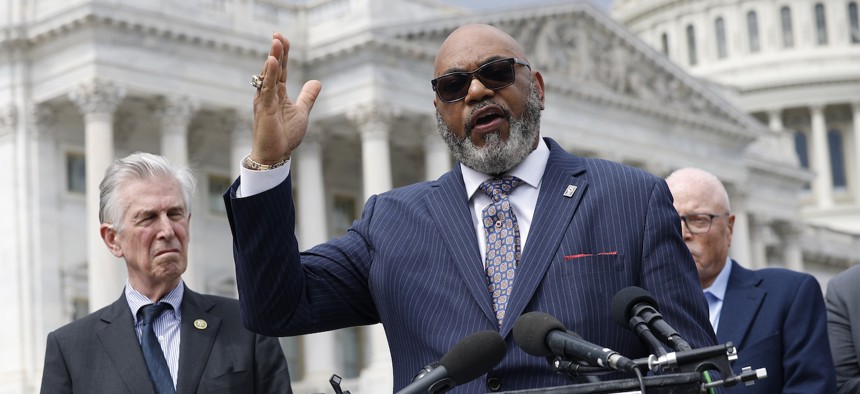
Everett Kelley (center), national president of the American Federation of Government Employees, warned that the move could portend Trump’s appointees to the authority putting their thumbs on the scale against unions. Kevin Dietsch/Getty Images




Federal labor board asserts political control over union elections
Union experts warned the move could set the stage for interference in union elections and determining the size of agency bargaining units.

The Federal Labor Relations Authority this week announced that its political leadership would assert greater influence on union elections and size and shape of bargaining units within agencies, a move that would upend more than four decades of precedent with little scrutiny.
Currently, representational matters at federal agencies are primarily handled by career staff at the FLRA’s regional directors’ offices, only going before the politically appointed three-member authority if a party files an appeal. Representational cases include requests to hold a union election, requests for an election to choose between multiple unions—or to choose not to bargain collectively altogether—as well as petitions seeking to amend or otherwise clarify the size, makeup and positions included within a bargaining unit.
But a pair of new rules published this week in the Federal Register would upend that practice, which has been in place since 1983. Beginning April 23, the FLRA’s three-member authority will work “collaboratively” with the agency’s regional offices, taking away parties’ appeal rights in the process. In its justification, the FLRA wrote that the result will be a “streamlined” process.
“After reexamination of its practices, the FLRA finds that the memorandum of delegated authorities and responsibilities to the [regional directors], and the related regulations governing representation matters, merit revision,” the rule states. “The FLRA envisions a streamlined process in which representation matters are resolved through the collaborative efforts of the regional offices and the authority—rather than a strict separation of an initial decision by an RD, followed by a possible appeal to, and potentially duplicative decision by, the authority.”
According to the rule, under the new process, parties seeking to file representation petitions will continue to do so through the FLRA’s regional offices, and the three-member authority will weigh in whenever a case requires it to exercise its “statutory responsibilities.”
“The FLRA anticipates that the regional offices will continue to conduct most investigations and hearings in representation matters after receiving the authority’s authorization, but authority staff may also be assigned those duties as needed,” the agency wrote. “Further, the FLRA intends, in most cases, for the regional offices to continue conducting elections with the authority’s authorization, but the authority will make decisions on election agreements and directions of election. Whereas, in most elections, the regional offices will continue to tally ballots and make determinations on election observers, the Authority will certify the results of elections. The Authority will address determinative challenged ballots in elections, and will decide all election objections concerning either the election process itself, or conduct that may have otherwise improperly affected the results of the election.”
FLRA Member Anne Wagner, the panel’s sole Democrat after President Trump fired then-chairwoman Susan Tsui Grundmann prior to the expiration of her term, dissented from the decision to amend its rules, arguing that such a major change in its operations should warrant seeking public comment prior to implementation via a proposed, not final, rule.
“Today’s revisions reflect the biggest changes to the FLRA’s representation case processing in nearly 43 years,” she wrote. “I believe that our stakeholders deserve an opportunity to review and comment on proposed regulations, and that we should consider such comments, before we make such sweeping operational changes."
Bob Tobias, distinguished practitioner in residence at the Key Executive Leadership Program at American University and former president of the National Treasury Employees Union said the handling of representation cases has been a “solved” issue for decades. Adding political appointees to initial processing of petitions and elections will make things slower, not faster, he said.
“The law is very well settled on what constitutes an appropriate [bargaining] unit and what the appropriate processes are to conduct an election,” he said. “The whole idea of filing for an election is to get it done as soon as possible, without delay. So this idea of creating new barriers and possible delay by the intervention of the FLRA in an election process makes no sense to me. There are no specific problems that have been defined by the FLRA that would necessitate their intervention.”
Everett Kelley, national president of the American Federation of Government Employees, warned that the move could portend Trump’s appointees to the authority putting their thumbs on the scale against unions as federal workers organize new—or protect the size of existing—bargaining units.
“The FLRA issued this rule without engaging in the legally required notice-and-comment process, instead attempting to minimize the significance of the rule,” he said. “Make no mistake, these changes are significant and substantive. They eliminate the non-partisan, non-political decision-making process that currently governs who can and can't be represented by a union. We should recognize this for what it is—just another step in this administration's efforts to politicize federal employment and make it easier to retaliate against those, including unions, that speak out against them.”
Share your experience with us: Erich Wagner: ewagner@govexec.com; Signal: ewagner.47
NEXT STORY: VA: Court order requires we reinstate union contract, not honor its terms