
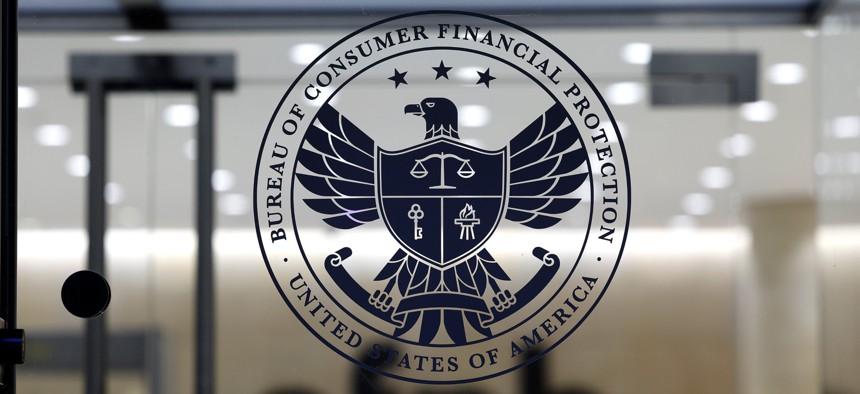
The entrance to the CFPB headquarters is seen during a protest on Feb. 10, 2025 in Washington, D.C. The U.S. Court of Appeals for the District of Columbia is currently weighing whether RIFs at the agency can proceed. Anna Moneymaker / Getty Images





Fate of CFPB employees hang in the balance as judges consider agency's future
The Trump administration is seeking authority to lay off nearly all employees at the consumer watchdog.

Judges on a federal appeals court discussed whether the Trump administration can lay off nearly the entire workforce at the Consumer Financial Protection Bureau during a hearing Tuesday, with the fate of the agency hanging in the balance as the court weighs a decision.
Much of the oral arguments focused on what relief the court may provide, including whether it can force CFPB not to lay off its workers. Eric McArthur, an attorney representing the agency on behalf of the Justice Department, said any employees challenging a layoff must take their case to the Merit Systems Protection Board. Many of the judges on the en banc panel questioned that perspective, noting MSPB does not have authority to overturn efforts to dismantle a federal agency.
The U.S. District Court in Washington last April paused mass reduction-in-force efforts, after CFPB had tried to lay off 90% of its staff—or around 1,500 employees. The U.S. Court of Appeals for the District of Columbia subsequently ruled that the RIFs could proceed. The court delayed their implementation while a union sought an en banc hearing before the entire appellate panel, however, and that panel in December threw out the initial appellate decision while it prepared to hear oral arguments.
McArthur disputed that the RIFs amounted to a dismantling of the agency, saying instead CFPB was merely seeking to lawfully downsize as responsible stewards of taxpayer dollars. Additionally, he said, CFPB’s actions—such as an email agency leadership sent last February to staff informing them the headquarters building was closed and instructing them to avoid conducting any work—were not final decisions and therefore could not be challenged under the Administrative Procedures Act. A recent Supreme Court ruling limiting the nature of preliminary injunctions further restricted the court from issuing a ruling that prohibits agency RIFs, McArthur said.
Jennifer Bennett, an attorney representing the National Treasury Employees Union, which brought the lawsuit, said an injunction preventing RIFs was appropriate to preserve the status quo while the other issues underlying the case are litigated. Picking and choosing which employees are necessary to carry out only certain functions would be unworkable, she added, while arguing CFPB has never presented a “lawful plan” for carrying out its layoffs.
Several judges on the panel suggested the court should remand the case back to the district judge to narrow the scope of the injunction. Others, however, expressed an openness to the plaintiffs argument that a more tailored ruling would be difficult to carry out in practice. If the court agrees with the district judge that efforts were underway to unlawfully shut down CFPB, they said, then it would stand to reason that employees must remain at the agency to ensure that does not occur.
Employees are still working, though they said they are doing so with diminished workloads. The agency has lost around 25% of the employees it had on board before President Trump took office. Late last year, CFPB attempted to defund the agency and warned employees widespread furloughs would result. The original district court judge on the case prevented that action, however, and funding has since been restored.
The bureau is funded as a percentage of the Federal Reserve’s operating expenses and the recently signed into law One Big Beautiful Bill Act lowered the cap for CFPB from 12% of those expenses to 6.5%. CFPB’s budget was $823 million in fiscal 2025.
While it cannot yet force any others to leave, the administration is taking steps to worsen the working conditions for staff.
After unilaterally altering its collective bargaining agreement and compensation agreement with its union, CFPB has cut off its workforce’s supplemental benefits, including dental and vision insurance and term-life insurance. It has also curbed performance bonuses and effectively issued pay cuts by altering the use of locality pay. NTEU, which represents CFPB employees, has filed complaints seeking to reverse the changes.
Share your news tips with us: Eric Katz: ekatz@govexec.com, Signal: erickatz.28
NEXT STORY: OPM formally proposes limiting top performance ratings for federal workers