
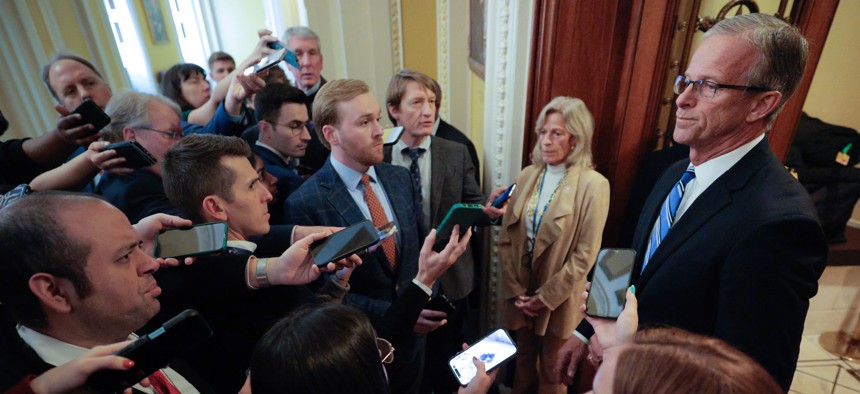
Senate Majority Leader John Thune, R-S.D., talks with reporters as he walks from his office to the Senate Chamber at the U.S. Capitol on Feb. 9, 2026. Congress is facing a Friday deadline to fund the Homeland Security Department, while language preventing reductions in force is also set to expire. Chip Somodevilla / Getty Images




Congress paused all federal layoffs for 3 months. That's set to change this week
A ban on agency RIFs is scheduled to be lifted after Feb. 13.

The Trump administration has not issued any new layoffs since Congress acted to temporarily block the personnel actions last year, but that legislative barrier is set for removal at the end of the week.
Federal agencies last sought to initiate new reductions in force in October as they attempted to leverage the lapse in appropriations to implement cuts to the civil service. Those efforts were paused by a federal judge and, later, statutorily blocked by Congress. Lawmakers in November included a provision in the spending measure ending the 43-day shutdown that prohibited any action to implement a RIF, effective from the start date of the funding lapse through Jan. 30.
The more recent four-day shutdown ended last week with a package that provided full-year appropriations for every agency that had not yet received it with the exception of the Homeland Security Department. To ensure DHS was able to fully operate, lawmakers extended the stopgap bill they had passed in November through Feb. 13.
In a joint statement to the federal court overseeing the longstanding lawsuit over President Trump’s RIFs, the plaintiffs and the administration noted that the new continuing resolution similarly extended the RIF moratorium through Feb. 13.
The relevant provision of the CR prohibits the use of federal funds “to initiate, carry out, implement, or otherwise notice a reduction in force to reduce the number of employees within any department, agency, or office of the federal government.”
Congress and the White House are currently negotiating over reforms to Trump’s immigration enforcement crackdown as part of a potential deal to fund DHS, but time to reach such an agreement—and get it through both the House and Senate—is running low. Senate Majority Leader John Thune, R-S.D., suggested yet another stopgap bill may be required for DHS.
“We need to keep working toward a solution,” Thune said from the Senate floor on Monday. “If it's going to take longer than a few days, we need to provide the time necessary to finish the job.”
It remains unclear, however, if Democrats would provide sufficient votes for such a measure or if it could reach Trump’s desk in time. Even if it did, it would not necessarily extend the pause on layoffs.
During the longer shutdown last fall, a smattering of agencies attempted to cumulatively lay off around 4,000 employees before a judge and Congress paused the efforts. Those RIFs, since rescinded, were set to impact the departments of Commerce, Education, Health and Human Services, Housing and Urban Development, Interior, Treasury, as well as DHS and the Environmental Protection Agency.
Additionally, State, Education, the Defense Department, the Small Business Administration and the General Services Administration sought to advance RIFs it had initiated prior to the shutdown. Those efforts were paused, however, after a federal judge ruled the congressional moratorium applied to them.
The Office of Management and Budget did not immediately respond to an inquiry into whether the administration would seek to resume RIFs if the moratorium is lifted. Agency officials had been planning some of the cuts, such those at Interior, well before the initial shutdown began in the fall, in part due to ongoing consolidation efforts.
Absent the context of a shutdown, the Supreme Court has largely greenlit Trump’s authority to remake the federal workforce as he sees fit.
Share your news tips with us: Eric Katz: ekatz@govexec.com, Signal: erickatz.28
NEXT STORY: OPM seeks to consolidate power over employee appeals in new regulations