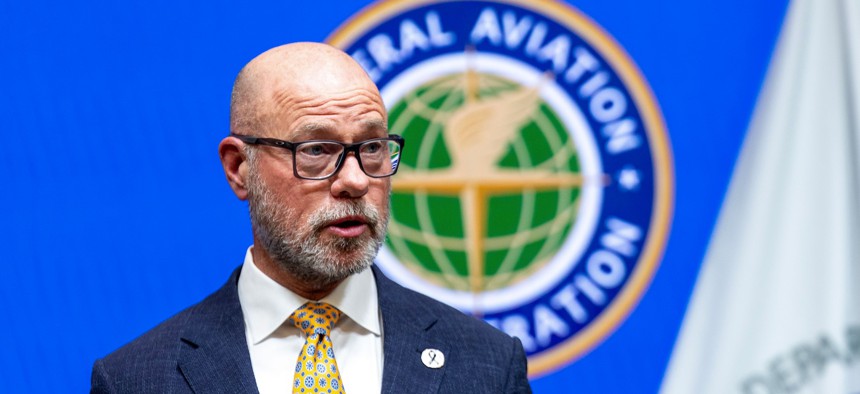
FAA Administrator Bryan Bedford defended that decision before the House Transportation and Infrastructure Committee on Tuesday. Tasos Katopodis/Getty Images




Air traffic controllers calling out sick during shutdown may have acted illegally, FAA chief says
Agency will “ask tough questions” of those workers even as administrator concedes agency has “a retention issue” among controllers.
The Trump administration is asking “tough questions” of certain air traffic controllers who did not report to work during the recent government shutdown, the head of the Federal Aviation Administration told lawmakers on Tuesday, after suggesting they may have taken unlawful action in response to their delayed paychecks.
Call outs of FAA employees led to major disruptions to air travel during the record-setting shutdown that ended last month, eventually leading the agency to mandate reductions in the number of fights taking place each day. FAA Administrator Bryan Bedford defended that decision before the House Transportation and Infrastructure Committee on Tuesday, though he said in some cases evidence suggested employees may have taken organized action to exacerbate the situation.
On a typical day, FAA takes action at a handful of facilities to correct for staffing issues. During the shutdown, that skyrocketed to a peak of 80 facilities per day. At some facilities, Bedford said, zero air traffic controllers showed up for work on some days.
“None of the controllers showed up for work,” Bedford said. “So we do have to ask some tough questions about: was that a job action.”
Federal employees are statutorily barred from participating in strikes or work slowdowns and in 1981, President Reagan summarily fired all air traffic controllers when they organized a work stoppage. The National Air Traffic Controllers Association worked closely with the Trump administration during the shutdown and repeatedly told its members it did not condone any collective action. Bedford suggested there may still be some disciplinary action forthcoming.
“That's not tolerable,” the administrator said of potential organized call outs. “So I think there is an accountability.”
FAA did not respond to an inquiry into whether or how many probes into employees are ongoing.
Transportation Department Secretary Sean Duffy previously suggested air traffic controllers who called out during the shutdown could face consequences, but he pointed to those who missed extended periods of time before the the employees saw their first paychecks delayed. Bedford, meanwhile, referred specifically to employees who may have collaborated with their colleagues to ensure no controllers reported to work.
Duffy’s comments followed similar remarks by President Trump who said controllers who missed time during the shutdown should be fired. Trump also vowed to provide $10,000 to FAA employees who showed up to work each day during the shutdown, though those bonuses only went out to a small fraction of qualified employees.
FAA has for many years lamented severe staffing shortages and Duffy has vowed to “supercharge” hiring for controllers. The agency met its goal of onboarding more than 2,000 such employees in fiscal 2025, Bedford said, and aims to hire between 2,200 and 2,500 ATCs in the current fiscal year on the way to hiring 8,900 employees over a four-year period. Additionally, FAA has boosted its inspector and engineer workforce with hastened hiring authority, relocation incentives and a focus on critical locations. Still, the administrator conceded the staffing issue is likely to linger.
“That’s the challenge,” Bedford said of high turnover rates. “We still see a lot of retirements. We see folks who frankly cannot take the pace of the work. We have a retention issue within the controller workforce.”
He added there was no “magic fix” to the staffing and retention issues, saying significant reforms and a collaborative relationship with NATCA would be required. President Trump has sought to unilaterally revoke collective bargaining rights for most federal employees, though he allowed for a carveout at FAA.
“When will we get our towers fully staffed?” Bedford said. “The honest answer is, if we continue business as usual, never. We’ll never catch up. The system is designed to be understaffed.”
While threatening discipline for some employees for their actions during it, Bedford acknowledged the shutdown had taken its toll on the workforce and recruiting efforts.
“Clearly the FAA culture needs a reset,” he said.
Rep. Hillary Scholten, D-Mich., questioned whether his comments, and those of Duffy and Trump, that denigrated those who called out during the shutdown would help achieve that goal.
“People get sick during a government shutdown,” Scholten said. “Threatening to fire them and maybe making people afraid, forcing them to potentially come to work when they're under the weather. Do you think that has an impact on morale?”
One FAA employee told Government Executive the approach would hamper the agency’s staffing efforts.
“The hostile environment is not helping efforts to hire ATCs,” the employee said. “Controllers are already leaving at higher rates than before this [administration] and it is a direct result of this irresponsible behavior.”
While he said it would yield long-term benefits, Bedford suggested the agency’s significant modernization overhaul would also lead to added turnover. FAA received $12.5 billion for its effort as part of the One Big Beautiful Bill Act, though the administrator stressed that was just a down payment on the total cost for his plans. Lawmakers criticized the selection of Peraton to oversee the project, citing its lack of direct experience in the field, though Bedford said FAA was not outsourcing the project and he would serve as chief accountability officer. He predicted the changes would lead to significant disruptions that upsets the workforce.
“It's uncomfortable for their bureaucracy,” Bedford said. “Some of them will leave. There will be turnover associated with that as we turn these processes on their head.”
Share your news tips with us: Eric Katz: ekatz@govexec.com, Signal: erickatz.28
NEXT STORY: Ethics agency spells out holiday do’s and don’ts for federal employees