

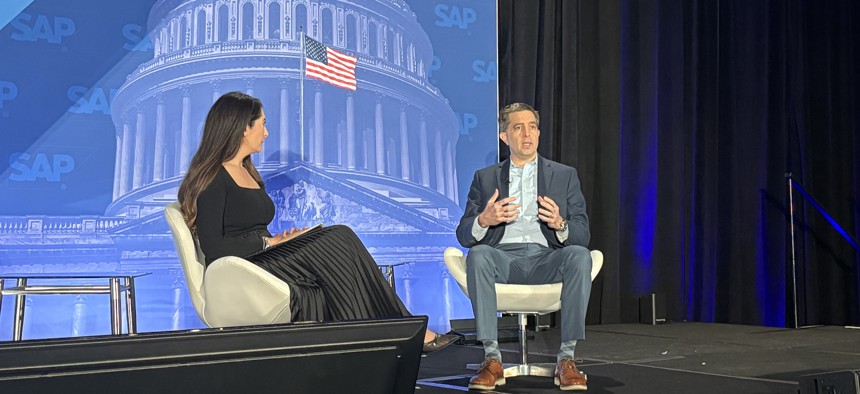
Secret service CIO and CAIO Chris Kraft speaks Oct. 15 at the SAP Public Sector Summit in Washington, D.C. Edward Graham/Staff



AI offers Secret Service unique mission enhancements, official says
Threats against the Secret Service’s full-time protectees are up over 40% since last year. The service’s CIO and CAIO Chris Kraft said AI “can help us as we investigate those threats, monitor those threats [and] bring together correlations between seemingly disparate information.”

Artificial intelligence is providing the U.S. Secret Service with new capabilities to carry out its protective and investigative missions, the agency’s IT and AI lead said on Thursday, with further adoption of the technologies poised to help it respond even better to future risk environments.
Given the Secret Service’s directive to both safeguard top U.S. officials and visiting dignitaries and to conduct criminal investigations, Chief Information Officer and Chief AI Officer Chris Kraft said “we have to look broadly at what's the art of the possible” when it comes to leveraging AI for its operations.
While Secret Service, like other federal agencies, has leveraged AI to streamline mundane back-office operations or other rote tasks — Kraft noted during the SAP Public Sector Summit in Washington, D.C., that “with generative AI, there's huge opportunity to automate things, such as invoice processing or contracts or other capabilities” — its unique mission positions it to utilize some of the more cutting-edge AI capabilities.
The service is trying to navigate an unprecedented threat environment with an understaffed workforce. During an interview with 60 Minutes on Sunday, Secret Service Director Sean Curran said threats against the agency’s full-time protectees are up more than 40% since last year, with around 10,000 threats made on those individuals since January.
“I believe that artificial intelligence can help us as we investigate those threats, monitor those threats [and] bring together correlations between seemingly disparate information,” Kraft said, referencing Curran’s interview. “I also think when you look at facial recognition and biometrics, [you see] the things that you can do — and at scale — with artificial intelligence.”
Kraft said, for instance, that an object detection tool could help the agency quickly identify how many individuals are in one space “at a speed that a human is not able to do that.”
The Secret Service currently lists three AI use cases in its most recent public inventory, with two of those uses — a model to support criminal investigations through facial recognition matches and another that is used to decipher license plates from poor-quality images or videos — currently deployed by the agency. Kraft said the agency’s AI adoption is meant to empower Secret Service’s human agents to better carry out their duties.
In an interview with Nextgov/FCW earlier this year, Kraft also said the Secret Service is working to embed AI specialists across its operations to help drive further adoption of AI tools.
Kraft highlighted that initiative on Thursday and said developing an internal AI team will allow experts to “go and work with different parts of the organization and accelerate, where it makes sense, our adoption of the technology.”