
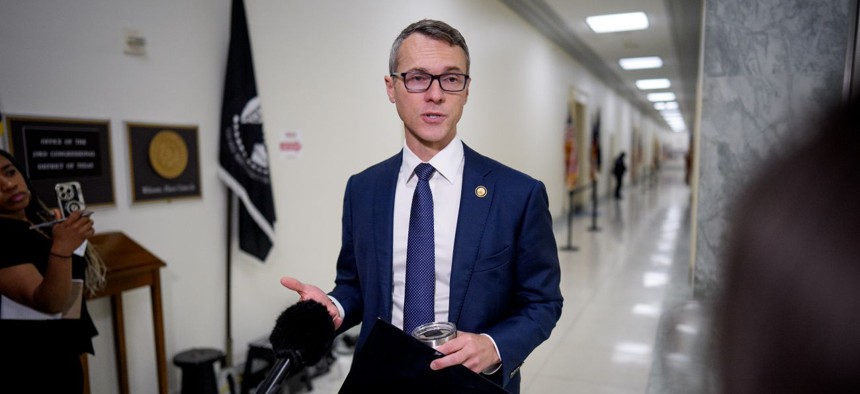
Rep. James Walkinshaw, D-Va., led a group of more than 100 lawmakers urging congressional leaders to advance legislation overriding President Trump's planned pay freeze for most civilian federal workers next year. Photo by Andrew Harnik/Getty Images


Lawmakers call on leadership to override Trump’s planned pay freeze
Members of both parties urged congressional leaders to “at minimum” authorize an across-the-board 3.8% pay raise for civilian federal employees, in line with President Trump’s supplemental pay increase planned only for law enforcement.

More than 100 members of Congress urged House and Senate leaders last week to advance legislation rejecting President Trump’s planned pay freeze for most civilian federal workers next year.
Last month, Trump issued his alternative pay plan, which formally confirmed the White House’s proposal to freeze most civilian workers’ pay at 2026 levels. Trump separately instructed the Office of Personnel Management to prepare to issue a 3.8% raise to federal law enforcement officers, and he has proposed pay increases between 5% and 7% for military service members, depending on their rank.
In a letter to House Speaker Mike Johnson, Minority Leader Hakeem Jeffries, Senate Majority Leader John Thune and Minority Leader Chuck Schumer, sent last week but published Monday, a bipartisan group of 110 lawmakers led by Rep. James Walkishaw, D-Va., and Sen. Chris Van Hollen, D-Md., warned that with inflation hovering over 3%, forcing federal workers to forgo a pay raise is “an effective pay cut.”
“The administration’s own proposal on federal pay increases demonstrates why such an increase is necessary,” they wrote. “President Trump has proposed that federal law enforcement personnel receive a 3.8% pay increase to improve recruitment and retention, and has proposed a 5-7% pay increase for service members given the critical support they provide our nation. The same rationale applies to all federal workers.”
The lawmakers said that a pay freeze risks exacerbating staffing shortages across government, including at the Veterans Affairs Department, Social Security Administration and the Food and Drug Administration. Unions and other federal employee organizations have similarly warned that a pay freeze would ultimately impact public service.
The letter cited Congress’ actions in early 2019 to override President Trump’s pay freeze for that year, implemented during the 35-day government shutdown, then instituting a 1.9% average pay increase retroactive to the beginning of that year. Lawmakers called on leadership to advance legislation that would “at minimum” reinstitute pay parity within the civilian federal workforce, extending the 3.8% raise to all feds.
“We strongly believe, however, that Congress should go further and provide the 4.1% increase called for in the [Fair Adjustment of Income Rates] Act, which would help federal pay keep pace with rising costs while ensuring the government can continue to attract and retain the workforce necessary to serve the American people,” they wrote.
When Congress has acted to codify federal employees’ annual pay increase in the past, it has traditionally done so through appropriations legislation. With the enactment last month of a continuing resolution keeping the government open until December, any action on this issue is unlikely prior to November’s midterm elections.
If you have a tip that can contribute to our reporting, Erich Wagner can be securely contacted at ewagner.47 on Signal.
NEXT STORY: Navigating the Pay.gov maze for federal retirement deposits