
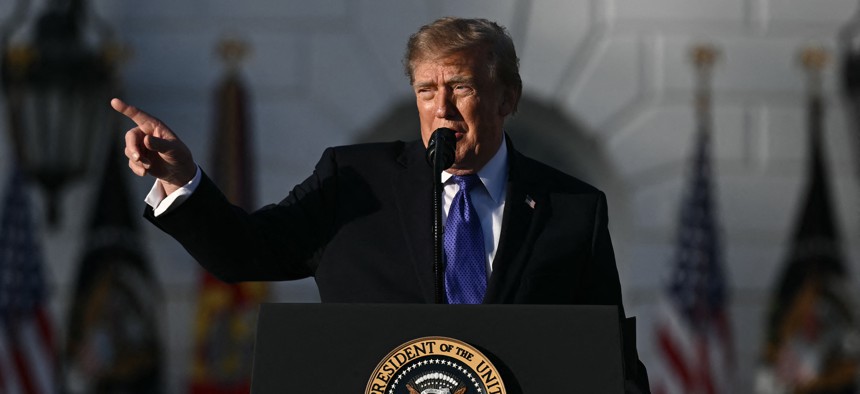
President Donald Trump speaks at a reception for the United States Marine band at the White House helipad in Washington, DC, on November 20, 2026. Trump issued an executive order regarding government contractors the same day. Photo by Brendan SMIALOWSKI / AFP via Getty Images



Trump’s new contractor executive order is an affront to Congress’ oversight authority
COMMENTARY | Due to a new executive order, contractors must now choose between an existential risk to their business today and contempt proceedings tomorrow.
On Friday night, the White House published a new executive order designed to stymie government contractors’ cooperation amid the surge in congressional oversight expected to begin once Democrats assume control of Congress in January. The order comes on the heels of the November midterms, when roughly 7 in 10 voters said Congress was not doing enough to check the president.
The November 20 executive order, “Protecting the Executive’s Privileges and Enhancing Efficiencies in Federal Contracting,” requires contractors and their subcontractors to notify the White House and contracting agencies of “any pending or future congressional request” concerning their communications or work with the executive branch. It also requires them to follow instructions to withhold communications that the White House or the agency has determined are protected by executive privilege.
To ensure compliance, the EO threatens contractors with contract termination and with suspension or debarment—the latter colloquially known as the “corporate death penalty” because it cuts off a contractor’s future government revenue streams.
The notification requirement alone is remarkable. When Congress asks a contractor about its dealings with the executive branch, this EO requires that the very branch under investigation be notified and coordinate the response—even if the request seeks nothing privileged.
The timing is obvious: many of the concerns that Congress is expected to raise in the new year are deeply intertwined with the federal procurement system. The last two years have been replete with wide-ranging allegations involving noncompetitive (“no-bid”) contracts; conflicts of interest; influence peddling; politicized contract awards, terminations, and blacklisting; and solicitations that openly give preferential treatment to politically aligned firms. As counterparties to many of the transactions Congress is expected to investigate, contractors are an important source of information, especially now that the White House has locked down agency employees.
The EO’s fact sheet accuses “certain congressional leaders” of threatening to intrude on “Executive prerogatives” and “harassing” the private companies that contract with the federal government. The White House claims an authority so expansive that it would render much congressional oversight of federal contracting off-limits: Congress, it says, cannot seek information from agencies, their employees, or federal contractors “without a valid legislative purpose that does not intrude on core Executive functions.” Congress does, of course, need a valid legislative purpose to issue a subpoena, but in Watkins v. United States, the Supreme Court expressly recognized that congressional investigative authority includes “probes into departments of the Federal Government to expose corruption, inefficiency or waste.”
Like many of the administration’s other ambitious and controversial executive actions, this EO is legally vulnerable. It invokes the Federal Property and Administrative Services Act (FPASA), a statute that empowers the President to set procurement policy to promote efficiency and economy. The EO attempts to justify itself by citing litigation costs and the need to protect sensitive information shared with contractors. Yet neither rationale supports such an expansive notification requirement. Congress’ constitutionally protected oversight authority is a critical procurement integrity tool—not an inefficiency that FPASA was designed to address. And ordering contractors to withhold information by threatening contract termination, suspension, or debarment invites the subpoena fights, contempt referrals, and constitutional challenges the EO claims it is trying to avoid.
The EO also empowers the White House and contracting agencies to determine what is privileged and to order contractors to withhold it, placing contractors in an extremely vulnerable legal position. In July, the D.C. Circuit held in United States v. Navarro that only the President or an authorized representative can invoke the presidential communications privilege and that a recipient’s belief that privilege applies does not justify defying a congressional subpoena. A contractor that withholds subpoenaed information at an agency’s direction without a valid privilege claim risks contempt.
The EO raises strong First Amendment concerns. The First Amendment generally prohibits the government from terminating a contractor’s existing contract in retaliation for speech on matters of public concern. Speech about potential violations of law in public spending clearly involves matters of public concern. Under Board of County Commissioners v. Umbehr, a court will weigh the government’s interest in protecting confidential information against the contractor’s First Amendment rights. Given that transparency in government contract spending is a foundational underpinning of the federal procurement system, the administration is on weak legal footing when a contractor gives Congress nonprivileged information about potential misconduct in public spending.
But the EO doesn’t need to survive a legal challenge or ever see a courtroom to have its intended effect. A hallmark of this administration has been a “flood the zone” strategy: announcing legally vulnerable policies and implementing them as quickly as possible, while letting the lawsuits challenging those actions play out over the months and years that follow.
The executive branch has long enjoyed broad discretion in administering federal contracts, and this administration has used that discretion in unprecedented ways. The administration’s actions since January 2025 have shown contractors how little recourse they have when their counterparty is a superpower: mass contract terminations under DOGE; pressure on contractors to renegotiate existing contracts and reduce the agreed-upon price; threats of suspension and debarment (a tool designed to protect the government, not to punish) against entities that don’t comply with administration priorities, and the designation of a company as a supply chain risk after a failed contract negotiation.
Contractors are likely to fear the executive branch more than Congress because the executive branch can punish a company first, long before any contempt case can be resolved. Agencies can terminate a company’s contracts, and its recourse is primarily limited to recovering certain costs and possibly pursuing litigation, which, even if successful, may not reinstate the contract. Agencies can also suspend a company, immediately cutting off its access to future contracting or subcontracting opportunities.
In trying to bolster its defenses against the forthcoming wave of oversight, the administration is once again treating its business partners as expendable—no more than political footballs. It is placing them in the impossible position of choosing between an existential risk to their business today and contempt proceedings tomorrow.
Contractors will bear the brunt of the White House’s political gamesmanship, but the public will be harmed as well. Congress appropriates the money that pays for these contracts, and its oversight is how the public learns whether the process was fair, transparent, and lawful, and whether taxpayers got value for their money. The White House should not be able to use its contracting power to shield its own conduct from that scrutiny or punish companies that cooperate with Congress’s constitutional oversight.
Jessica Tillipman is the Associate Dean for Government Procurement Law Studies at The George Washington University Law School, where her scholarship and teaching focus on procurement integrity, government ethics, and anti-corruption law.