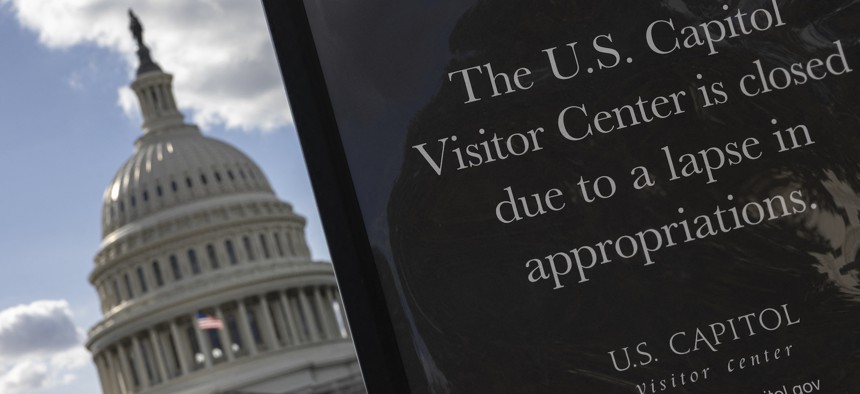
The U.S. Capitol on Oct. 2, 2025, which was the second day of what would become the longest government shutdown. MEHMET ESER / Getty Images

Watchdog won’t discipline agencies over partisan shutdown posts but warns against ‘derogatory’ messaging
Many departments blamed congressional Democrats for last year’s funding lapse by posting banners on agency websites and modifying furloughed employees’ out-of-office messages.

The Office of Special Counsel on Friday said that it is not pursuing disciplinary action over widespread messaging from agencies blaming the fall 2025 government shutdown on Democrats because officials misconstrued an earlier Hatch Act decision that they thought permitted the communications. But OSC staffers were not able to correct that misinterpretation at the time because they were furloughed due to the funding lapse.
The Hatch Act is an ethics law enforced by OSC that limits the political activities of federal employees. Specifically, civil servants are not permitted to engage in political activity while on duty or in their official capacity.
In the report, OSC said that it received more than 1,000 complaints about partisan messages from the White House and 37 agencies during the record-breaking shutdown, which ended in November.
At the time, Democratic lawmakers and good government nonprofits pointed to banners on agency websites blaming congressional Democrats for the shutdown and furloughed Education Department employees reporting that their out-of-office messages were modified to express the same sentiment as examples of Hatch Act violations.
OSC also cited a satirical webpage from the White House called “mysafespace” that pretended to be a social media profile for congressional Democrats.
“That fake profile contained a biography section that included, ‘Hey we’re Democrats in the House and Senate. We love DEI, transgender for everyone, and handing out taxpayer benefits to illegal immigrants,’ listed as heroes ‘anyone who identifies as a radical leftist[,] transnational gangs, [and] illegal immigrants,’ and made multiple references to the shutdown.”
Agencies generally defended these messages to OSC by referencing a 2024 advisory opinion finding that former Education Secretary Miguel Cardona did not violate the Hatch Act when he sent a letter to federal student loan borrowers criticizing lawsuits from “Republican elected officials” that temporarily blocked certain student debt forgiveness plans.
In that opinion, OSC staffers determined that there wasn’t evidence suggesting Cardona intended to influence election results and that the agency historically hasn’t considered references to a political party in discussions of pending legislation or government policy to constitute prohibited political activity.
OSC employees in Friday’s report said that the earlier opinion was not intended to be applied so broadly but that agencies’ interpretation was “understandable, especially because agencies could not consult OSC for clarification during the shutdown because OSC’s Hatch Act Unit staff was furloughed.”
“Because of agencies’ reasonable reliance on the 2024 advisory, OSC has determined that disciplinary action is neither warranted nor appropriate in the shutdown messaging cases,” they wrote. “Further investigation to determine facts like how the communications were developed and the roles of individual employees would tax OSC’s limited resources and not materially change the outcome.”
The agency clarified, however, that similar partisan messaging in the future still could run afoul of the Hatch Act.
“Some of the shutdown messaging had the clear non-electoral purpose of influencing pending legislation — namely the pending appropriations bills that would have restored government funding — while others had the non-electoral purpose of conveying operational impacts. Neither is prohibited under the Hatch Act,” staffers wrote. “But the derogatory tone and broad dissemination of some communications might weigh in favor of finding that their purpose went beyond influencing legislation to affecting the outcome of future elections, a purpose the Hatch Act prohibits.”
The Senate in August confirmed Charles Baldis, a former GOP Senate staffer, as special counsel, though he’s been leading OSC since spring 2025 as the designee of the former acting chief. In 2025, the president removed the former special counsel — Hampton Dellinger, who was appointed by President Joe Biden — before the end of his five-year term.
In August, the nonprofit Citizens for Responsibility and Ethics in Washington sent a letter to OSC criticizing the length of time it is taking to complete Hatch Act investigations into six senior administration officials, five of which have been pending for more than 10 months. In response, the agency said that it “doesn’t comment on open cases.”
If you have a tip that can contribute to our reporting, Sean Michael Newhouse can be reached securely at seanthenewsboy.45 on Signal.
NEXT STORY: ICE’s $45 billion detention expansion is littered with costly missteps, watchdog reports