

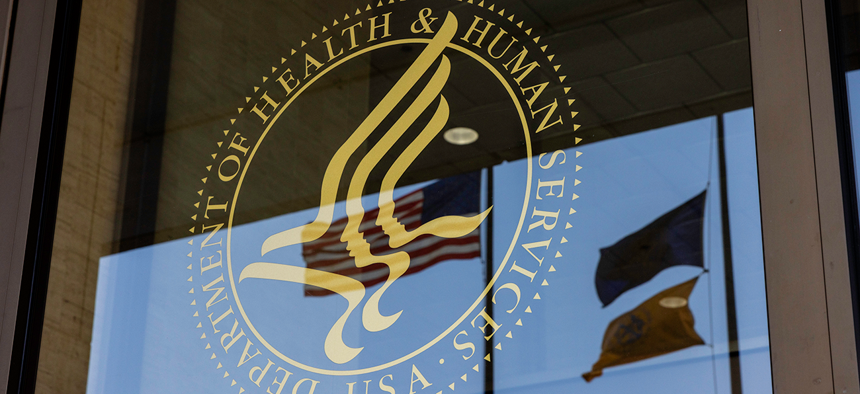
The death of a SAMHSA employee has reopened deep wounds across HHS, where workforce cuts and other traumatic events have left many employees struggling. Robb Hill for The Washington Post via Getty Images



At HHS’s mental health agency, a suicide deepens anguish among workforce
News of a SAMHSA employee’s death has brought on a renewed wave of grief for the HHS workforce, which has faced other traumatic experiences in the workplace.
EDITOR’S NOTE - This story includes discussion of suicide. If you or someone you know needs help, the national suicide and crisis lifeline in the U.S. is available by calling or texting 988. There is also an online chat at 988lifeline.org.
An employee working in the Health and Human Services Departmental substance abuse and mental health services agency died by suicide last week, according to two individuals familiar with the matter.
A Public Health Service officer died in the Substance Abuse and Mental Health Services Administration's headquarters, located in the Parklawn Building in Rockville, Md., between the close of business Thursday and Friday morning. According to one individual, security did not find her overnight during sweeps of the building.
“The loss of a dedicated public servant is felt not only by colleagues but also by the many people whose lives were touched by her compassion, encouragement, and commitment to helping others,” an online obituary states.
SAMHSA is responsible for operating the 988 National Suicide and Crisis Lifeline and supports a wide range of services to fight addiction and support individuals in recovery.
A SAMHSA spokesperson told Government Executive in a statement that “we are deeply saddened by the death of one of our colleagues,” and that “our heartfelt condolences are with the employee’s family, friends and colleagues.”
“Supporting our staff affected by this loss is an ongoing priority. We are continuing to inform employees of available support services,” the SAMHSA spokesperson said. “Out of respect for our colleague and the family, we will not be sharing details and ask that their privacy be respected during this difficult time.”
Jonathan White, an HHS official who left the department last year, said employees were in the office when first responders arrived on the scene. White said SAMHSA did not immediately allow employees to leave the office to work from home, but did send a notice later that day permitting employees to telework.
Mental health experts say there generally is not a single explanation or single reason behind a suicide. White, a mental health clinician with expertise on trauma in the workplace, told Government Executive that suicide is generally a consequence of depression and other mental health symptoms.
“The issue, in some ways, is not, and cannot be, ‘Why did she die by her own hand?’ Because in real life, that’s not a question you can ever answer,” White said.
Word of the employee’s death, however, has brought on a renewed wave of anguish for the HHS employees who have recently dealt with other traumatic experiences in the workplace.
“Feds have been continuously attacked for a year and a half, and it is taking a toll on them. I'm not suggesting, because there's no way of knowing, whether this is the central factor in her own death by suicide. But it is absolutely, I can say with certainty, the defining feature of the way that this news has spread through the PHS and HHS. It is becoming a symbol of what this administration, and particularly Secretary Kennedy's team, has done to workers in HHS,” White said.
In March 2025, a child and maternal health issues specialist at the Centers for Medicare and Medicaid Services’ Innovation Center in Woodlawn, Maryland, died by suicide, according to an online obituary shared with Government Executive.
In August 2025, a gunman opposed to the COVID-19 vaccine opened fire on the Centers for Disease Control and Prevention’s headquarters in Atlanta, killing a responding police officer.
White said that “this incident, for many people, brought right back to the surface the emotions they felt after the shooting at CDC a year ago.”
“There is a mental health crisis for HHS feds right now, both those still inside government and those who've been displaced. And for those inside government, it's quite severe,” he said.
HHS Secretary Robert F. Kennedy commemorated the one-year anniversary of the attack by visiting CDC’s headquarters on Aug. 7, 2026, where he met with the family of slain police officer David Rose and participated in a fireside chat with agency employees.
The Washington Post reported that Kennedy during the chat called for greater scrutiny of scientific findings.
“You can’t just trust a scientist, because scientists have biases, too,” he said, according to the Post. He also said the CDC’s data was too difficult to access, describing as “shocking” how inaccessible the databases are. “They’re all hoarding their own data.”
CDC initially allowed employees impacted by the shooting to work from home, but called them back to the office two weeks later. Kennedy acknowledged the CDC campus shooting in a statement three days later. As of the one-year anniversary of the shooting, building damage from gunfire still hasn’t been fully repaired.
Former CDC Director Susan Monarez told the Senate Committee on Health, Education, Labor and Pensions in a September 2025 hearing that Kennedy did not call her after the shooting.
SAMHSA saw the largest staffing cuts of any HHS component last year. The Trump administration cut SAMHSA’s workforce by more than half through layoffs and voluntary separation incentives that broadly targeted HHS departmentwide.
“The people who could leave all left. The folks left in are mostly people who do not perceive they have an option, and that of course includes many in the PHS,” White said.
HHS more broadly has put new restrictions on reasonable accommodations for employees with a disability or medical condition – including, in some cases, post-traumatic stress disorder. Last month, the department began administratively closing out accommodation requests over missing paperwork – although impacted employees provided Government Executive with evidence that they provided it.
In January 2026, SAMHSA briefly rescinded about $2 billion in grants for mental health and drug addiction before walking back those plans.
“SAMHSA has lost much of its staff and its capacity to do things, and elsewhere in HHS, many PHS officers are experiencing very severe traumatization and fatigue from the combination of the constant orders to violate scientific integrity and undermine science … the constant messages of blame and fault from the secretary that they are the reason Americans are sick – the constant climate of fear about the next RIF. It is impossible to convey unless you spend time with HHS career feds,” White said.
If you have a tip that can contribute to our reporting, Jory Heckman can be securely contacted at jheckman.29 on Signal.
NEXT STORY: Here’s how the Trump administration may face pushback from a Democrat-controlled Congress