

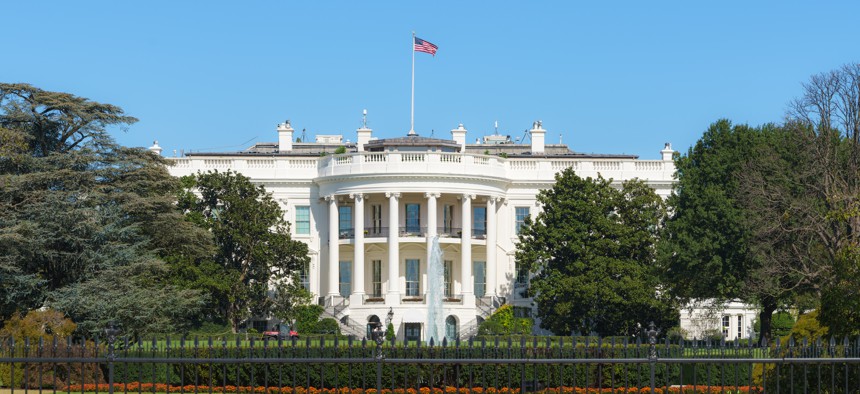
The Trump White House has installed a historically high number of political appointees. Prasit photo / Getty Images




Trump quietly hired political appointees under a new job classification, good government group reports
While Schedule G is not officially set up in regulation, the Office of Personnel Management emphasized that the position category for political appointees was established by executive order and that the agency issued implementing guidance.

The Trump administration installed political appointees at agencies under a new job classification before the position category was formally set up, according to a good government nonprofit, which argued that this incident furthers a trend of officials showing a lack of transparency regarding federal workforce reforms.
In July 2025, the president issued an executive order creating Schedule G, a new job classification for non-Senate-confirmed political appointees in policy-making or policy-advocating roles. Officials said at the time that roles under the category would be targeted to the Veterans Affairs Department.
Shortly thereafter, the Office of Personnel Management issued guidance to agencies on making Schedule G appointments. The government’s HR agency proposed a rule establishing Schedule G in regulation in September; the deadline for members of the public to comment on the proposed rule is Nov. 17.
The Partnership for Public Service reported that, based on publicly reported information, it didn’t appear that the administration was using Schedule G — until last week when updated data on presidentially appointed positions maintained by OPM showed that there are at least 25 individuals serving under the classification. Researchers noted that the number could be higher.
“The [OPM] data reflects what agencies report to OPM, and agencies have discretion over what they share,” Chris Piper wrote. “Twenty-five is what we can see, not necessarily what exists.”
Of the 25 individuals, 22 work at the VA. Researchers emphasized that the earliest appointee began serving in August 2025, more than a year before OPM proposed the Schedule G regulation.
“The fact that the public can see who holds political appointee positions offers transparency, and thus a tool for public and congressional oversight and accountability,” Piper wrote. “But in the case of Schedule G, for more than a year, officials served in a new appointment category with no public record, and the only acknowledgment came through an unannounced data update rather than a report or a press release.”
OPM countered that, even without a final rule, there are still formal guardrails for Schedule G because of its implementing guidance to agencies as well as the executive order itself.
“The pending proposed rule would make conforming amendments to [the Code of Federal Regulations]; it does not establish the underlying authority for Schedule G,” said OPM press secretary Kiki Nyoh in a statement to Government Executive. “The executive order also cited improving operations at the Department of Veterans Affairs as a rationale for creating the new schedule.”
At the same time as the president has downsized the civil service, the Partnership reported that Trump, at the end of this first year in office, installed more political appointees under Schedule C (i.e. confidential or policy-determining positions) than any other administration in the last 40 years.
If you have a tip that can contribute to our reporting, Sean Michael Newhouse can be reached securely at seanthenewsboy.45 on Signal.
NEXT STORY: ICE resists automatic activation of body cameras despite oversight concerns