

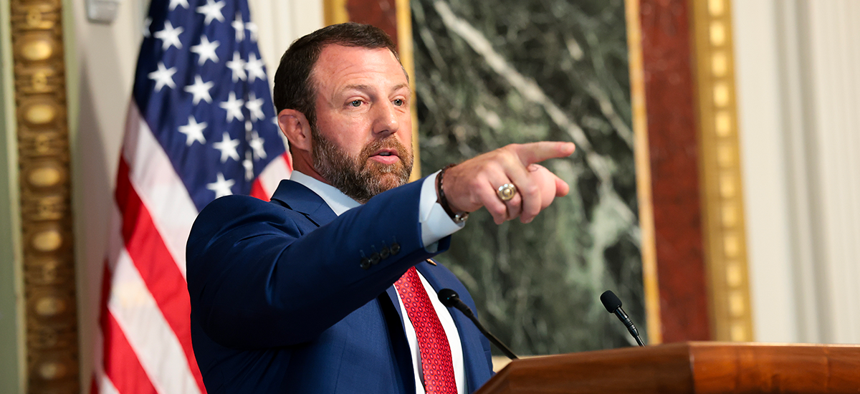
DHS Secretary Markwayne Mullin says Federal Emergency Management Agency is relying on IT upgrades to do more with fewer employees, a familiar refrain from agency heads under the Trump administration. Anna Moneymaker/Getty Images




DHS secretary defends smaller FEMA workforce after judge challenges 50% staffing cut plans
Markwayne Mullins pointed to technology investments as a way for the disaster agency to operate with a smaller workforce, even as a federal judge in San Francisco ruled that DHS "unlawfully ordered” FEMA to cut its staffing by half.

The Department of Homeland Security’s top leader is defending staffing reductions at its emergency response agency, even though it is no longer pushing plans to cut its workforce in half.
DHS Secretary Markwayne Mullin told reporters on Monday that the Federal Emergency Management Agency is relying on technology upgrades to do more with fewer employees, a familiar refrain from agency heads under the Trump administration.
“It's not always personnel that you need,” Mullin said in a roundtable discussion on disaster-relief efforts in Nebraska. “Efficiency is what you need.”
A federal judge in San Francisco ruled last Friday that DHS under the leadership of former Secretary Kristi Noem “unlawfully ordered” FEMA to cut its staffing by 50%.
U.S. District Court Judge Susan Illston wrote that DHS “unlawfully usurped” the authority of FEMA leaders to make their own personnel decision, including managing the size of its workforce.
While FEMA is a component agency of DHS, legislation signed into law by former President George W. Bush following Hurricane Katrina established FEMA as a “distinct entity” within DHS and prohibited the DHS secretary from significantly reducing “the authorities, responsibilities, or functions” of FEMA.
Illston determined that the order to cut FEMA staffing in half “came from DHS,” and that FEMA officials did not agree with the 50% staffing cut. Mullin, however, chided Illston, saying that judges shouldn’t “get into the hiring and firing of an agency.”
“When some federal judge tries to come in and tell us how many people we have to have on staff, yet they're not in the building, they're not running the agency, is laughable. Stay in your lane, deal with the law,” he added.
The Government Accountability Office found in August that FEMA shed 17% of its workforce – about 4,300 employees – in fiscal 2025. GAO auditors wrote that these staffing cuts led to a “loss of institutional knowledge and experienced personnel,” and exacerbated workforce challenges.
FEMA Administrator Cameron Hamilton said the agency is now a “more lean organization,” and that its IT investments will allow FEMA to push out payments at a “faster pace with far less bureaucracy.”
“We're looking to overhaul our entire IT footprint, so we ultimately get better customer service to clients, which are the states, which ultimately represent who the American people,” Hamilton said. “We owe them that, and with those new processes, you're going to find that funding disbursements will actually be a lot faster.”
Mullin said the focus for FEMA should be getting federal disaster funding to state and local governments as quickly as possible.
“FEMA was never designed to be the first responder. It was there to be there on your worst day to help the state, to help the local government recover, not take over and take charge of the situation,” he said. “When we're doing this, we want to make sure we get it right. President Trump is wanting to reform government. We want to get it right.”
Mullin said that, as a former senator, he’s used to hearing agency heads insist that hiring more employees is necessary to increase capacity. But he said FEMA is able to do more with fewer employees because of its technology upgrades.
“Throwing people at a problem that aren't passionate about, or not being an added value to it, doesn't help. For some reason, we're constantly getting – not just with FEMA, but all across the federal agencies – they're saying, ‘You can't let people go. You’ve got to keep them there,” he said.
Mullin added that in many large organizations, “20% of the people do the majority of the work, 80% of people do their job, and that, “in a disaster, you need 100% of people doing the majority of the work every single day.”
The American Federation of Government Employees, which is leading a much broader lawsuit challenging the Trump administration’s plans to shrink the federal workforce, asked the court to intervene after FEMA terminated hundreds of workers by declining to renew their expiring contracts.
The non-renewed employees were all part of FEMA’s Cadre of On-Call Response and Recovery (CORE) workforce, who serve in two or four-year terms. CORE employees are often the first to deploy following a disaster and, according to the lawsuit, some of the terminated workers were in the middle of hurricane relief deployments.
FEMA officials last December submitted a plan to DHS officials that would bring the agency’s headcount down to about 11,383 employees, roughly half its current workforce.
In a deposition last year, former acting FEMA Administrator Karen Evans said the agency was tasked with coming up with a topline number for staffing cuts before developing an analysis of how to reach that total.
Senior FEMA and DHS officials discussed staffing plans over the messaging app Signal on their personnel cell phones, and set up messages to be automatically deleted after a few weeks. Illston wrote that Signal messages most relevant to the case “have been deleted and cannot be recovered.”
“Frankly, the FEMA staffing plan number appears as if pulled from thin air,” Illston wrote, but suggested that deleted Signal messages “would have shed light on how this number came about.”
In May, the FEMA Review Council created by President Donald Trump backed away from proposing deep staffing cuts at the agency. The council recommended in its final report that FEMA employ less staff to respond to disasters and offer fewer opportunities for assistance to those impacted by them, but urged the agency conduct a review to determine “appropriate staffing levels.”
Illston wrote that there is “no indication at present” that FEMA is carrying out its earlier plans to cut its workforce in half. However, she wrote that DHS “continues to usurp FEMA’s authority to renew CORE terms,” and that CORE employees are currently being renewed for shorter-than-usual terms.
Illston is directing both sides in the lawsuit to confer on options for resolution in this case.
If you have a tip that can contribute to our reporting, Jory Heckman can be securely contacted at jheckman.29 on Signal.
NEXT STORY: Judge grants temporary pause in USDA relocations in new lawsuit