
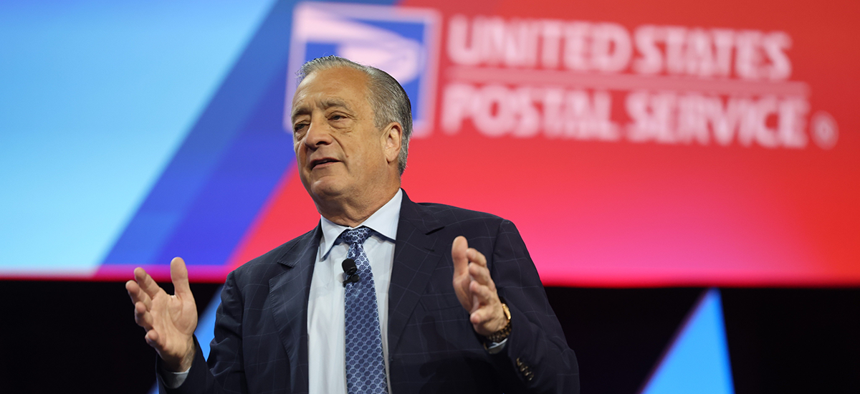
Postmaster General David Steiner says USPS stands in the middle of policy decisions largely out of its control. U.S. Postal Service




‘Not our decision,’ USPS chief says, as agency faces mail-in voting lawsuits and a looming cash crisis once more
Postmaster General David Steiner says USPS “is not a political organization,” as it carefully navigates its way through yet another round of election mail lawsuits and urges Congress for help to avoid running out of cash.

The Postal Service is dealing with a familiar pair of challenges: legal scrutiny over its capacity to deliver mail-in ballots ahead of the fast-approaching election season, and a plea to Congress to help the agency avoid running out of cash.
In the lead up to this year’s midterm election, several federal lawsuits are challenging the Trump administration’s executive order imposing new rules on mail-in voting.
USPS is also once again at risk of running out of cash. The agency is calling on Congress to take up a legislative package meant to help put the agency on firmer financial footing – either through annual appropriations or a cost-cutting package that may include shuttering post offices and reducing delivery days.
It’s a déjà vu moment for USPS. In 2020, federal courts scrutinized the nearly insolvent agency’s readiness to deliver an unprecedented volume of mail-in ballots, a process that is now fairly routine. About one in three U.S. voters cast ballots by mail.
Postmaster General David Steiner, in a wide-ranging interview, told Government Executive that regarding these two issues, the legal battle over mail-in ballots and reforms to its struggling finances, USPS stands in the middle of policy decisions largely out of its control.
Steiner said USPS “is not a political organization,” and is prepared to carry out its end of executive order if the courts ultimately rule in favor of the administration, or comply if the courts decide to permanently block the EO’s implementation.
“We deliver the mail. Someone else makes the rules. We deliver the mail, and so we deliver the mail under the rules that are put on us, and that's exactly what we'll do. People can fight over whether the rules are valid or not. Once that fight is finished, we'll do whatever the courts say we can do. That's not our decision,” Steiner said.
The Supreme Court allowed USPS on last Monday to proceed with a final rule on its implementation of the executive order. Last Thursday, a federal judge in Massachusetts granted a temporary restraining order blocking USPS from carrying its final rule. But the ruling has already been appealed, and may soon head back to the Supreme Court.
Plaintiffs in the lawsuits argue the cash-strapped USPS is being directed to implement new restrictions with no time left to vet these changes ahead of Election Day. The Trump administration argues its order isn’t “restricting” mail-in voting, but introduces “modest envelope design requirements" on states that mail ballots to voters.
“You just can't do nothing”
USPS has floated the possibility of Congress providing “modest appropriations” – at least in the short term – to keep the agency from running out of cash. That would bring USPS more in line with its earlier business model, when it functioned as a Cabinet-level agency.
Absent those funds, Steiner said USPS will need to scale back days of delivery, shutter unprofitable post offices, and reduce the size of the USPS workforce – but the agency can’t make these changes without approval from Congress.
“Both issues are the same thing: other people make the policy, we just enforce it. On the EO, we're going to follow the rules that we get given. On the business, we don't get to make the policy decision. Congress gets to make the policy decision,” Steiner said.
Since 1971, the Postal Service has operated more like a business, funded largely through its own revenue. But an accelerating decline in mail volume has left the agency with few options to stay afloat through its own actions.
Steiner said he’s “agnostic” on which choice Congress makes, but said granting short-term funding would allow USPS to keep providing its same level of service to the American public.
“All I'm asking Congress to do is pick one of the policies,” Steiner said. “You just can't do nothing, because if you do nothing, we're out of business.”
Making mail-in ballots 'more safe and secure'
If the courts ultimately allow USPS to proceed with implementation of the executive order, Steiner said the agency has the capacity to make changes in a short period of time.
“It's really not dramatically different than what we've been doing for years,” Steiner said. “Not sure why it creates such a kerfuffle.”
Under the final rule, any state that plans to use mail-in or absentee ballots must provide USPS with a list of participating voters. USPS is also tasked under the executive order with launching a Federal Mail Ballot Portal for states to upload their voter lists.
“We don't compile the list. We don't review the list. We don't do anything with the list other than to make sure that the ballots on that are listed on that list are ballots that get delivered to the customer,” Steiner said.
The final rule also establishes new barcode and envelope-formatting requirements. USPS provided nonbinding guidance to states in previous elections, but now says it will reject ballots that don’t meet its standards.
Outbound ballots, USPS wrote in an FAQ, “will be rejected if during verification prior to acceptance the Postal Service cannot match the unique Intelligent Mail barcode on the envelope with the data in the Federal Ballot Mail Portal."
Steiner said the barcode requirement is very similar to the agency’s longstanding guidance, and “reduces the amount of work for our folks.”
“Honestly, if we could put that into law, we would put it into law, because it makes the mail more efficient,” Steiner said. “It makes it easier for us to deliver ballots, it makes it easier for election officials to trace the ballots. No one can disagree that that is a more efficient way, from our perspective, and from the mailer's perspective, to track and understand the mail.”
As part of a 2021 settlement with the NAACP and Public Citizen, USPS has agreed to deploy “extraordinary measures” for mail-in ballots ahead of subsequent elections. That includes extra deliveries and collections, special pickups, expanded hours at processing plants, Sunday collections and visual checks of various points for ballots. Steiner said these measures will remain in place for the 2026 election, noting that while they are costly for normal mail, the agency has performed them for years and views them as a “non-issue” from a cost perspective.
But postal experts remain wary about USPS’ capacity to roll out new changes just a few months out from Election Day.
Robert Fisher, a former USPS executive, postal consultant and the founder of the Research Alliance for Postal Policy, said USPS has done a “great job” delivering ballots in previous elections, but “to do what’s being asked in the short term, it’d be a disaster.”
“The scope of it, the complexity it adds, having to deal with so many exceptions to longstanding practices, it’s going to be a disaster, in spite of heroic efforts,” Fisher said.
Mike Plunkett, a former USPS manager for pricing strategy and innovation and manager of retail alliances, now president of the Association for Postal Commerce, said the last time USPS was asked to pull carry new, complex work in a short amount of time was working with the Biden administration to mail COVID-19 tests to households at the height of the pandemic.
“This, to me, seems orders of magnitude more difficult technically, because they have to coordinate among 50-plus states and territories. If you compile that list, and then put in place acceptance procedures for thousands of locations that will allow them to do verifications against those lists within less than 10 weeks, that is a tall order,” Plunkett said.
Voters are slated to receive mail-in ballots well ahead of Election Day.
“I have no idea how many disputes this will create, because inevitably there will be disagreements between the postal officials and the election officials,” Plunkett added. “And there’s no existing dispute resolution processes in place that I’m aware of, so they will have to create that on the fly too.”
President Donald Trump has been openly skeptical of mail-in ballots. Politico first reported that Trump, who is registered to vote in Florida, cast his vote in the state’s Republican primary via USPS.
Asked about vote-by-mail skepticism, Steiner said USPS has a solid track record of delivering ballots quickly and on time. In the 2024 election, the agency delivered ballots in 1.4 days on average.
“Yes, it's safe and secure. Can it be more safe and secure? Absolutely. All I can talk to is the part that we are responsible for. I don't know what happens to a ballot once it shows up in your hand. Is something going on there? No idea,” Steiner said. “Our job is to move mail, and when we move ballot mail, we move it safely and securely. Now, that's when it's in our possession, right? What happens to that ballot when it's outside of our possession? No idea. Could there be something going on? No idea.”
“Don't let that change the sense of urgency”
After the midterm elections, USPS will still need help from Congress to avoid running out of cash. There's a chance these negotiations may require support from a Democratic majority in the House or Senate, depending on the outcome of the election.
Steiner said USPS will be submitting a legislative proposal to Congress in “weeks, not months.”
Lawmakers have been critical of USPS leadership in recent public hearings, but Steiner noted that private talks with the Congressional Postal Service Caucus and the appropriations committees have ”been very constructive.”
“It's a problem-solving session, which I thoroughly enjoy,” Steiner said about these closed-door meetings. “Obviously, the hearings are more theater, but the private conversations we've had have been spectacular.”
USPS estimates that its public service obligations cost the agency about $6-9 billion annually to carry out. Given an accelerated decline in mail volume, Steiner has proposed Congress partially fund USPS through annual appropriations, or free up the agency to close post offices and reduce delivery days.
“I don’t think we need that amount of money to be profitable. I think it’s more like $4-6 billion. I think that would be the range that we’d be in,” Steiner said about the agency’s appropriations request.
According to the National Association of Postal Supervisors, USPS is authorized to request up to $460 million from Congress each year as “public service reimbursement.” But the agency hasn’t requested or received any public service reimbursement since 1982.
“All we're asking is let's bring that concept back. If you're going to ask us to do things that lose money, pay us for that,” Steiner said.
Steiner said Congress could put in a provision in the spending package that requires lawmakers to revisit USPS appropriations about every five years, because by then, the agency could be in better shape financially.
Steiner said three things are losing USPS money – its legal obligation to deliver mail and packages to every address six days a week, an inability to set its own prices without approval from its regulator, and keeping all of its post offices open, even though 60-70% of them are unprofitable.
“Take those shackles off of us, we'll be profitable in six months. Not hard. Let us operate like a business. If our mandate is to make money, let us operate like a business. We'll make money in six months. Now you're going to have less days of service. You're going to have less post offices. You're going to have higher prices, so that's one policy choice. The other policy choice is fund the mandates.”
If Congress doesn’t act on a legislative package for USPS this year, Steiner said the mail agency will be forced to consider lowering service standards, raising prices and closing thousands of “unprofitable” post offices.
“If we don't have a legislative solution, which I hope we will – or at least a view to a legislative solution. We don't have to have an actual bill, but I'd like to know which way Congress is going. If we don't know that by, call it first quarter of 2027, we'll start closing post offices. We'll start looking at how we can reduce service levels, and we'll do everything we can on pricing.”
Earlier this year, Steiner told lawmakers that USPS would run out of cash in early 2027, if it kept meeting all of its financial obligations. But the agency now expects to avoid a cash crisis until about 2031 by suspending its contributions to one of its employee retirement plans. USPS also put new restrictions on nonessential spending to avoid running out of cash sooner than expected.
Steiner stressed that USPS is buying itself more time through emergency measures – not paying its contributions to the Federal Employees Retirement System (FERS) – and that Congress should not see this as an opportunity to “kick the can down the road.”
“If we do nothing now, not only are we out of money, our employees' retirement is out of money in 2031,” he said. “We had to do that to keep the doors open, but don't let that change the sense of urgency for you. Don't think that things are rosy. We are borrowing from our employees' retirement. It's what I told Congress, we're not comfortable with that. Our employees aren't comfortable with that. They shouldn't be comfortable with that.”
“I get the frustration”
Congress passed long-awaited reform legislation in April 2022 that saved USPS $107 billion in total costs. USPS warned lawmakers that it was also on the verge of running out of cash at the height of the COVID-19 pandemic, and received $10 billion in pandemic relief funds.
Congressional Republicans backed the 2022 Postal Service Reform Act after USPS rolled out its 10-year Delivering for America plan, championed by former Postmaster General Louis DeJoy.
Lawmakers and the agency’s regulator have soured on the plan, arguing that projected USPS cost-savings haven’t justified declines in on-time delivery. In June, two of Trump’s nominees to serve on the USPS Board of Governors told the Senate Homeland Security and Governmental Affairs Committee that was time for the agency to come up with a new long-term plan.
“I get the frustration,” Steiner said. “We got out over our skis. We promised profitability, and you can see we didn't achieve profitability.”
At its core, the plan envisioned getting USPS to “break even” by cutting costs and boosting revenue through a reconfiguration of its postal processing facilities and transportation network. Under DFA, USPS is also running trucks less often between processing plants and post offices to transport mail, under a “Regional Transportation Optimization” (RTO) strategy.
Steiner said “it’s time to step back and take another look at” DFA, acknowledging that for some of its customers, elements of the 10-year plan have become shorthand for unreliable service.
“When they hear DFA, they think, ‘My letter didn't show up, it must be DFA.’ Whenever their letter’s late, they go, ‘RTO.’ They don't even understand what it is, but it's become sort of a catchphrase for all the problems of the Postal Service,” Steiner said. “End-to-end visibility will take the occurrences of that happening, and shrink it dramatically.”
More than a year into the job, Steiner has emphasized the need for USPS to improve on-time delivery metrics. Steiner said some elements of the DFA plan, including its overhaul of postal facilities, will result in greater efficiencies and growth in its shipping and packages business.
“The capital's been spent. It would be foolish to say let's start over,” Steiner said. “We now know how to operate the network, but we will operate it so much more efficiently when we know where every piece is at every point. And right now, we don't. We know where it is at certain points in the network, but we don't know every place, every point.”
“How do we fix it for the American public?”
As the head of USPS, Steiner holds meetings with lots of stakeholders. At times, he’s met with the president. Steiner said he’s met with Trump “a couple of times,” the first being when he interviewed for the job of postmaster general. Trump also met with DeJoy and former Postmaster General Megan Brennan.
“I wouldn't say that we've had deep strategic conversations. I've given him sort of the 50,000-foot view,” Steiner said.
In his initial meeting with the president, Steiner said he also met with Commerce Secretary Howard Lutnick.
“Howard has been hugely helpful. I don’t have a lot of conversations with the president. I’ve had quite a few with Howard, and Howard's goal is how do we make things faster, better, cheaper for the American public,” he said.
USPS has partnered with the Census Bureau on a small-scale test of the 2030 population count.
“[Lutnick] came to me at the very beginning and said, ‘Can you guys do the Census?’ He said, ‘Look, we're sending people out to get information on the Census, and we're sending them out 10 different times, and people aren't home. You guys go by every house every day. You are the absolute logical people to do this,’ and so we started a couple pilots in that regard,” Steiner said.
As USPS looks for ways to overcome its long-term financial problems, Steiner said he’s looking for more opportunities to collaborate with other agencies.
“I don’t talk to the president, but I talk to the administration, and everybody to a person in the administration has been hugely helpful in trying to figure out how to fix this, and every single one of them goes about it by saying, ‘How do we fix it for the American public?’” he said.
If you have a tip that can contribute to our reporting, Jory Heckman can be securely contacted at jheckman.29 on Signal.
NEXT STORY: Why a smaller government isn't automatically better