
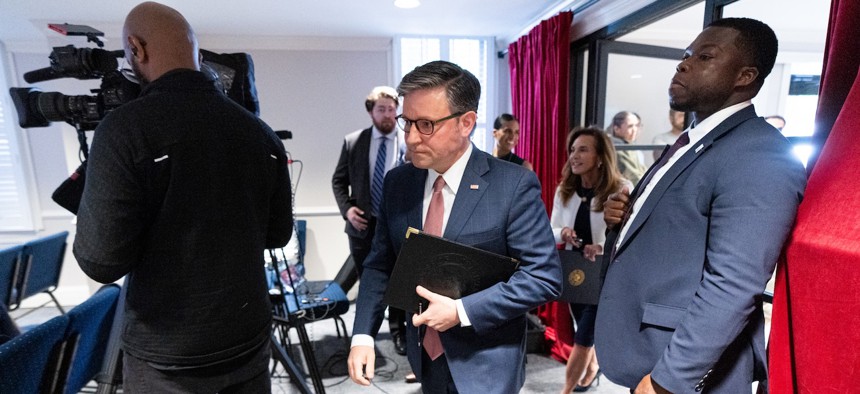
House Speaker Mike Johnson, R-La., (center) arrives for the news conference following the House Republican Conference caucus meeting at the Republican National Committee headquarters on May 13, 2026. Bill Clark/CQ-Roll Call, Inc via Getty Images




Secret Service funding fight sharpens over White House modernization push
House Republicans are backing a funding request tied to White House grounds upgrades while lawmakers demand more detail on how the agency would spend the money.
House Speaker Mike Johnson on Wednesday pressed for increased funding for the Secret Service, arguing most of the money Senate Republicans included for the agency in their immigration enforcement bill is for security needs, not building a new ballroom at the White House.
The Louisiana Republican added during a morning press conference he didn’t want to “prejudge” the $72 billion package before the Senate approves a final version this month and sends it to the House.
“I don't have the pen in the Senate. They’re writing the bill,” he said. “We’ll see what we get.”
Johnson noted there are several more steps the legislation must go through in the Senate, including a review by the parliamentarian to make sure all provisions fit within the strict rules of the reconciliation process, committee debate and a marathon amendment voting session on the floor.
Johnson said President Donald Trump “is excited about building a ballroom with private funding,” though that project comes with additional needs that will likely require taxpayer dollars.
“The Secret Service says that as we enhance the White House grounds and the modernization there that obviously we have to think differently about security,” he said. “We live in a very dangerous time and there are new and increasing threats that we have never faced before. And so Congress has a role in funding that and we’ll have to see how it all works out.”
Urgent request
Johnson asserted the bill Senate Republicans released last week “very specifically defined” how the Secret Service could use the additional funding.
The legislation would provide $1 billion available until Sept. 30, 2029, for “security adjustments and upgrades … to support enhancements by the United States Secret Service relating to the East Wing Modernization Project.”
The bill would limit the Secret Service from using any of the funding “for non-security elements.”
Johnson said GOP lawmakers added the funding to the immigration enforcement spending bill after the Secret Service “put in an urgent request for additional security measures.”
“We’ve needed some of these security measures for a long time,” he said. “And that’s what this is all about.”
Congress provided the Secret Service with $3.25 billion in the annual funding bill for the Department of Homeland Security that lawmakers passed in late April.
Republicans approved an additional $1.17 billion for the Secret Service in their “big, beautiful” law that the agency can use through September 2029 for personnel, training, technology as well as performance, retention and signing bonuses.
Normally, the White House budget office would publicly send Congress a supplemental spending request, asking lawmakers to approve the additional money. That would then be vetted by the Appropriations Committees, though that didn’t happen in this case.
The Trump administration also could have included a boost in funding in the budget request officials sent Congress in early April that asked members to approve $3.5 billion for the Secret Service in the annual funding bill for the agency due by the end of September.
Funding breakdown
Secret Service Director Sean Curran gave Republican senators more details about how the agency plans to use the additional funding during a closed-door lunch this week, though the bill would not actually require the agency to spend the money as outlined.
A breakdown obtained by States Newsroom showed:
-
$220 million would go to “hardening” the East Wing Modernization Project with additional bulletproof glass, drone detection technologies and filtration systems designed to detect chemical or other contaminants.
-
$180 million would go toward construction of a “long overdue” White House visitor screening facility.
-
$175 million would bolster Secret Service training as well as its training facilities.
-
$175 million would help the agency “secure frequently visited venues facing heightened risk due to their public visibility and static nature.”
-
$150 million would go to the branch of the Secret Service that focuses on drones, aircraft incursions, biological threats and “other emerging threats” through investments in state-of-the-art technologies.
-
$100 million for “high-profile national events that require significant planning.”
Republican senators said after that meeting they wanted more information from the Secret Service on exactly how the agency would spend the additional funding before they vote on the package.
Thune predicts passage next week
Senate Majority Leader John Thune, R-S.D., said Wednesday morning most GOP senators will ultimately support the additional funding for the Secret Service “that's needed to enable them to do their jobs.”
“Obviously there are security implications related to the modernization of the East Wing. And that represents, I think, of the total request that Secret Service made, about 20%,” he said. “The balance of it, I think, are things that they've been putting off for a long time, but need to be done, especially in a modern threat environment where you've had, you know, now, three assassination attempts in the last two years.”
Thune said his “aspirational timeline” is to have committees debate their bills early next week, followed by floor action on the full package later in the week.
“It can always be affected by other factors,” he said. “But I think at least right now, that's the goal.”
Senate Minority Leader Chuck Schumer, D-N.Y., said during a floor speech that Trump’s focus on building a “gilded ballroom” shows the president “is living in the theater of the absurd.”
Schumer said Americans don’t want to see government leaders focused on the ballroom project when inflation, food costs and gasoline prices have all increased.
“I would say Trump has completely lost touch with the American people, but that would assume that Trump was ever in touch with the American people to begin with,” he said. “And on this issue he sure as heck isn’t.”
President Donald Trump has promoted the ballroom project as part of a broader White House modernization effort.