

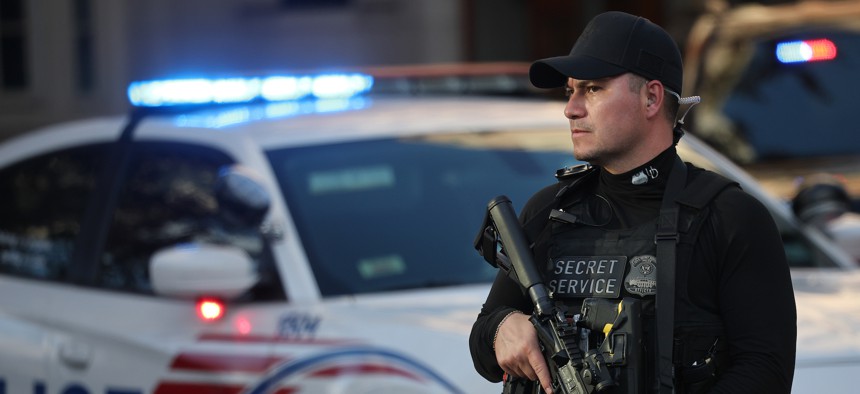
A member of the U.S. Secret Service, with a police car in the background, secures the area near a shooting near the White House on Nov. 26, 2025. Win McNamee / Getty Images



Bipartisan bill would authorize the Secret Service to reimburse state and local police for assistance
The Fraternal Order of Police said in a statement that local law enforcement often work with the Secret Service but have to rely on their own resources.

The Secret Service would be authorized to reimburse state and local police departments for assisting with the protection of the president and vice president under bipartisan legislation introduced on Monday.
Rep. Greg Landsman, D-Ohio, who sponsored an earlier iteration of the bill in 2024, said that he became interested in this issue after hearing from local law enforcement officers that their resources were being drained due to providing protective services for Vice President JD Vance, who is from Ohio.
The Secret Service-Local Law Enforcement Partnership Act (H.R. 7876) would authorize $61 million for each of fiscal 2026, 2027 and 2028 to reimburse state and local law enforcement for “protection activities directly and demonstrably associated” with security for the president, vice president as well as major presidential candidates and former presidents and vice presidents.
Landsman’s measure is cosponsored by Rep. August Pfluger, R-Texas, and is backed by the Fraternal Order of Police.
“Cooperation between the U.S. Secret Service and local law enforcement is a vital part of ensuring the safety and well-being of the president, the vice president and others who require protection details,” said the organization’s National President Patrick Yoes in a statement. “What is often left unaddressed, however, is the cost that many law enforcement agencies incur while cooperating with the Secret Service, which can place an undue financial burden on agencies throughout the country. This money would be used towards purchasing equipment, hiring personnel and other necessary items to ensure that law enforcement agencies have the tools needed to assist the USSS.”
The bill also would require the Homeland Security Department, the Secret Service’s parent agency, to provide Congress with an update on its implementation of recommendations from a 2023 DHS inspector general report that found the Federal Emergency Management Agency, another DHS component, in the past has not ensured that Presidential Residence Protection Assistance grants were properly spent by state and local police.
The PRPA grant program reimburses state and local law enforcement for overtime costs due to protecting any of the president’s non-governmental residences. The DHS IG reported that in fiscal 2019 and 2020 FEMA reimbursed recipients $8.9 million for unallowable overtime fringe benefits and $10.2 million for protection activities that were not directly associated with such residences.
Rep. Tom Kean Jr., R-N.J., has sponsored similar legislation (H.R. 2131) that would authorize the Secret Service to reimburse state and local police for providing protection to former presidents and major presidential candidates since July 12, 2024.
The congressman said in a press release that his Presidential Security Resources Reimbursement Act is a response to increased presence by state and local police at Donald Trump’s properties in Florida, New Jersey and New York following the July 13, 2024, assassination attempt against the president. The measure is cosponsored by Reps. Lois Frankel, D-Fla., and Suhas Subramanyam, D-Va.
Both Landsman’s and Kean’s bill have been referred to the Judiciary Committee, but neither has been voted on yet.
Share your experience with us: Sean Michael Newhouse: snewhouse@govexec.com, Signal: seanthenewsboy.45
NEXT STORY: Hegseth ramps up pressure on Defense civilians to deploy for immigration enforcement