

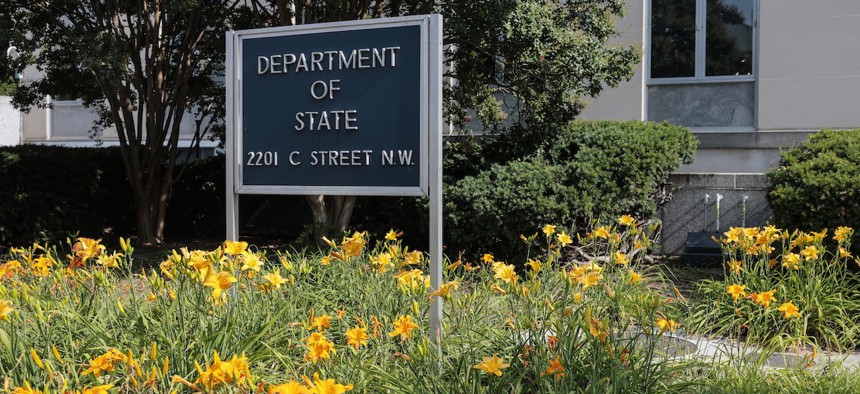
In Trump’s second term, some 80% of names the White House has sent to the Senate have been political rather than career civil servants, writes Donald Heflin. Anna Moneymaker/Getty Images




What happens when the State Department loses its institutional memory?
COMMENTARY | With dozens of ambassadorial posts still vacant, the staffing of U.S. embassies is raising questions about the role of career diplomats and the experience needed to carry out American policy overseas.
Just before leaving town on Sept. 30, 2026, U.S. senators confirmed 10 new ambassadors. Among those nodded through before Congress closed for an extended midterm recess were new U.S. ambassadors for Kenya, Nicaragua, Malaysia and Kyrgyzstan.
That’s commendable – many of those countries hold geographical or strategic importance for U.S. diplomacy. But it still leaves 92 out of 196 ambassador jobs currently unfilled. In some of those cases, the White House has not sent names to Capitol Hill despite the second Trump administration being a year and a half into the job. In others, the Senate, which is controlled by the same party as the White House, hasn’t acted on the names put forward.
Regardless of the reason, as a former ambassador and an expert in the process of diplomacy, I find the current vacancies concerning. Among those embassies still without a top person in place are key partners for the U.S. – countries that Washington needs to achieve its security, economic and strategic objectives.
What makes these vacancies more worrying, in my view, is that they come amid other concerning developments in the State Department’s staffing of embassies.
Politicizing diplomacy
Chief among them are the high percentage of politically appointed ambassadors relative to positions filled by career diplomats – that is, senior foreign service officers, usually with at least 20 years of diplomatic experience.
Though many countries send politicians abroad as ambassadors, America’s diplomatic service is unique in two ways. The percentage of U.S. ambassadors who are political appointees – those who haven’t followed a career civil service path – is higher than comparative countries across the world. Second, those political appointees are often donors with little to no government experience.
The practice has existed for decades, but in recent years the number of political appointees has increased. During the Obama administration, the percentage of political appointees was around 30%. The number rose to around 40% in the first Trump administration and the subsequent Biden administration.
But in Trump’s second term, some 80% of names the White House has sent to the Senate have been political.
And many of the people Trump has put forward don’t appear to have the credentials usually associated with holding important diplomatic positions. Rather, many are friends, associates or donors to Trump, often with little overseas experience or knowledge of the country they are going to.
Lee Lipton, ambassador to a key ally in the Philippines, is owner of a restaurant in Palm Beach – Florida Benny’s on the Beach – a member of Trump’s Mar-a-Lago Club and a contributor to his political campaign. The ambassador to Greece is Kimberly Guilfoyle, a former Trump adviser and ex-fiancée of his son Donald Jr.
The system of political appointees has always had an element of handing ambassadorships to friends and supporters. But what has changed under Trump is the range of positions now available. In the past, ambassadors to key countries like Chile, Israel, Peru, the Philippines, Turkey and Egypt, for example, have almost always been career appointees. This has changed under the second Trump administration.
Appointing noncareer diplomats to small, faraway nations has the additional problem that the chosen individual may not actually spend much time there. The rule of thumb has long been that ambassadors should spend no more than one month every year back in the United States. But that is compromised if a noncareer diplomat with expansive business ties in the U.S. is selected.
The role of a deputy
A closely related problem is the State Department’s handling of an ambassador’s second in command, their deputy chiefs of missions – DCMs for short – under Secretary of State Marco Rubio.
During Trump’s first term in the White House, politically appointed ambassadors were often encouraged to swap out the DCMs they inherited from their predecessors. It meant going through a long hiring process, leaving those key jobs unfilled for months.
In 2025, the State Department went further, canceling the assignments of senior officers en route to take up embassy jobs and opening a new hiring process.
It formed part of a Trump purge of what many MAGA Republicans characterized as a “deep state” civil service. The reality is that DCMs fill a critically important role in helping political appointees navigate the bureaucracy and implement their policy ideas, as well as raising the occasional reality check.
With more politically appointed ambassadors – some of them with no relevant experience – having an experienced DCM can be the difference between success and failure.
Looking for other friends
When you put all of these personnel changes together, the result is the degradation of what was once seen as one of the most effective diplomatic services in the world.
What makes this potentially more worrying is where the vacancies are. For example, Belarus and Bulgaria, neighbors to Russia and Ukraine, are without U.S. ambassadors. And important countries in the fight against terrorism or in geopolitical hot spots, such as Kuwait, Qatar and Mauritania, are in the same camp.
Other countries still without ambassadors include Indonesia, Southeast Asia’s largest nation and the most populous Muslim-majority country in the world; key Middle East ally Egypt and nuclear power Pakistan; and nations the U.S. needs to help manage inward migration, such us Haiti and Guatemala.
The problem of absent or inexperienced ambassadors goes both ways. It means Washington may not have a capable diplomatic figurehead in these countries to contact in times of need. There are also fewer avenues for host nations to successfully convey messages back to the U.S. administration.
When faced with absent ambassadors, amateurish political appointees and deputy mission chiefs who are very junior or career appointees with short resumes, host countries may conclude that they aren’t seen as important to the U.S. and start looking elsewhere for friends.
And the U.S. has hollowed out its ambassadorial corps at a time when it is facing growing international influence by the likes of Russia, China and Iran – rival nations hoping to capitalize on a perceived diplomatic void left by Washington.
For example, as the U.S. tries to contain Beijing’s influence in the Asia-Pacific region, Fiji, Indonesia and Laos remain without U.S. ambassadors. Similarly, China’s diplomatic relations with Pakistan – a former key security partner for Washington – have grown while the ambassadorial seat in Islamabad remains empty.
And former Soviet states including Georgia, Kazakhstan and Uzbekistan don’t have U.S. ambassadors even as Russia President Vladimir Putin attempts to consolidate Moscow’s regional influence.
In large areas of the world, such as Africa and the Pacific region, and in important areas of policy, the lights may be on in U.S. embassies, but nobody’s home. And that is a distinct problem for national security and strategic interests.

Donald Heflin, executive director of the Edward R. Murrow Center and Senior Fellow of Diplomatic Practice, The Fletcher School, Tufts University
This article is republished from The Conversation under a Creative Commons license. Read the original article.